
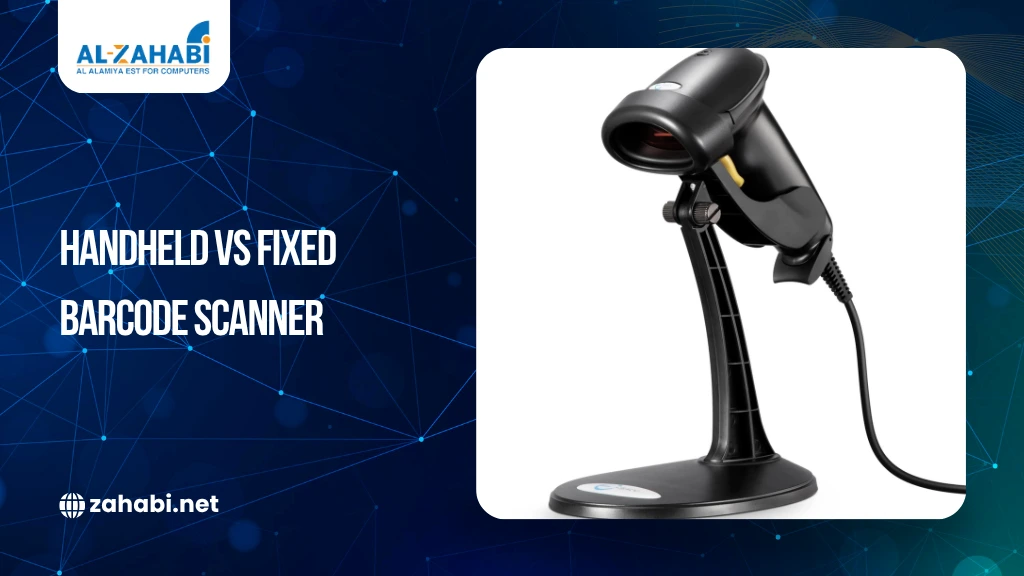
Choosing the right barcode scanner for POS is not just about scanning speed. It affects how smoothly your checkout operates, how quickly staff can handle customers, and how efficiently your store functions during peak hours.
In Kuwait’s retail landscape, where stores range from compact convenience outlets to supermarkets and specialty retail formats, the decision between a Handheld barcode scanner and a fixed-mount barcode scanner depends on real operational needs, not just features.
This guide explains the differences practically, with examples from actual retail environments, so you can make a decision that holds up in daily use.
Why the Right Barcode Scanner Matters at Checkout?
At the billing counter, the scanner is one of the most frequently used tools. Any delay or inconsistency at this stage directly affects customer experience.
A reliable POS barcode scanner in Kuwait helps ensure:
- Faster checkout during busy hours
- Fewer scanning errors or missed items
- Reduced pressure on billing staff
- Consistent transaction flow
Even a small delay per customer can add up during peak periods. Over time, this impacts both revenue and customer satisfaction.
Handheld Barcode Scanners – A Detailed Overview
A Handheld barcode scanner is designed for flexibility. It allows staff to bring the scanner to the product rather than the other way around.
How Does it Work in Practice?
The staff member uses a trigger to scan each item manually. Most handheld scanners can read barcodes from different angles and distances, making them suitable for varied product types.
Where Handheld Scanners Perform Best?
They are particularly useful in situations where:
- Products are bulky or heavy
- Items cannot be easily lifted onto the counter
- Barcodes are placed in awkward positions
- Staff need to move around during billing
Real Example – In electronics stores or home appliance outlets, products such as televisions or large boxes are not moved to the counter. Staff use handheld scanners to scan items directly on the shop floor or trolley.
Operational Advantages
- Greater flexibility for staff
- Ability to handle diverse product sizes
- Useful for both checkout and inventory tasks
Limitations to Consider
- Slower compared to fixed scanners in high-volume billing
- Requires manual handling for every item
- Can lead to fatigue during long shifts
Fixed-Mount Barcode Scanners – Clear Breakdown
A fixed-mount barcode scanner is installed at the checkout counter and is designed for continuous, high-speed scanning.
How Does It Work in Practice?
Items are passed over or placed in front of the scanner, which reads the barcode automatically. There is no need to press a trigger or adjust angles manually.
Where Fixed Scanners Perform Best?
A fixed scanner in Kuwait is widely used in:
- Supermarkets with high customer flow
- Convenience stores with quick transactions
- Retail environments with standardized product sizes
Real Example – In grocery stores, items are quickly moved across the scanner surface. The system reads barcodes instantly, allowing the cashier to process multiple items in seconds.
Operational Advantages
- Faster scanning speed
- Hands-free operation
- Consistent performance across transactions
- Reduced physical effort for staff
Limitations to Consider
- Limited flexibility for large or irregular items
- Requires proper counter space and setup
- Less effective if barcodes are damaged or poorly placed
Handheld vs Fixed Barcode Scanner: Detailed Comparison
| Feature | Handheld Barcode Scanner | Fixed Mount Barcode Scanner |
| Scanning Speed | Moderate | High |
| Flexibility | Very high | Limited |
| Staff Effort | Higher | Lower |
| Accuracy | Depends on handling | Highly consistent |
| Best Use Case | Bulky or varied products | High-volume retail |
| Space Requirement | Minimal | Requires counter setup |
| Learning Curve | Easy | Very easy |
What Works Better for Retail POS in Kuwait?
The right choice depends less on the device itself and more on how your store operates on a daily basis. Factors such as transaction volume, product type, store layout, and staff workflow all influence which scanner performs better in practice.
Retail environments in Kuwait vary widely, so the most effective solution is one that aligns with actual usage rather than assumptions.
For High-Volume Retail Stores
Supermarkets, hypermarkets, and large grocery chains benefit significantly from fixed scanners. In these environments, speed and consistency are essential to maintain a smooth checkout flow.
A fixed-mount barcode scanner allows cashiers to process items quickly without manually aiming or triggering the scanner. This reduces transaction time per customer and helps manage long queues during peak hours.
Why it works well:
- Continuous, hands-free scanning improves speed
- Consistent performance across large volumes
- Reduced physical effort for staff during long shifts
In busy supermarkets, even a few seconds saved per transaction can result in hundreds of additional customers served in a day. Fixed scanners help achieve this efficiency without increasing staff.
For Small or Specialized Stores
Retail stores that deal with varied product sizes or non-standard items often rely more on flexibility than speed alone.
A Handheld barcode scanner is better suited for:
- Electronics stores with bulky items
- Furniture or appliance showrooms
- Stores with irregularly shaped products
Why it works well:
- Staff can scan items without moving them
- Easier handling of products with hard-to-reach barcodes
- Useful beyond checkout, such as for stock checks
Real-world example – In an electronics store, scanning a large television or boxed appliance at the counter is impractical. A handheld scanner allows staff to scan items directly in the cart or display area.
For Mixed Retail Environments
Many retail businesses in Kuwait operate in a hybrid format where both speed and flexibility are required. In such cases, using both scanner types together is the most effective approach.
This setup allows:
- Fixed scanners to handle high-frequency, standard items
- Handheld scanners to manage exceptions such as large or poorly labeled products
Benefits of a hybrid approach:
- Faster checkout for most transactions
- Flexibility for edge cases
- Reduced dependency on a single system
This combination is increasingly common in modern retail setups because it balances efficiency with practicality.
Why Scanner Quality and Brand are Important to Consider?
The performance of a scanner is not determined only by its type. Build quality, scan accuracy, and durability play a major role in long-term performance.
A reliable Datalogic barcode scanner is widely used in retail environments because it is designed for continuous operation and consistent accuracy. These devices are built to handle damaged or low-quality barcodes, high scanning frequency, and long operating hours without a performance drop.
In addition, options like a Honeywell barcode scanner are preferred for their durability in demanding retail environments, while a Zebra barcode scanner is known for its reliability and smooth integration with POS systems, especially in high-volume setups.
These devices are built to handle:
- Damaged or low-quality barcodes
- High scanning frequency throughout the day
- Long operating hours without a performance drop
A Datalogic scanner typically offers faster response time and better scan reliability, which reduces delays at checkout.
Why does this matter in real operations?
In busy retail environments, scanners are used hundreds or even thousands of times per day. A device that struggles with damaged barcodes or requires repeated scans can slow down the entire checkout process.
Investing in a dependable retail barcode scanner reduces downtime, minimizes errors, and ensures smoother daily operations.
Real Retail Scenarios in Kuwait
Understanding how different store types operate helps in choosing the right scanner setup.
Supermarkets
Fixed scanners handle most transactions efficiently, while handheld scanners are used for large items or special cases. This combination ensures both speed and flexibility.
Convenience Stores
These stores focus on quick, high-frequency transactions. Fixed scanners are preferred because they allow rapid billing with minimal effort.
Electronics Stores
Due to large and varied product sizes, handheld scanners are more practical. They allow staff to scan items without moving them to the counter.
Fashion Retail
Depending on store size and layout, many fashion retailers use a mix of both scanners. Fixed scanners handle billing, while handheld devices assist during busy periods or for stock checks.
Key Factors to Evaluate Before Choosing the Two
Making the right decision requires a clear understanding of how your store functions daily. A scanner that works well in one environment may create inefficiencies in another. Evaluating these factors carefully helps ensure that your investment supports both current operations and future growth.
1. Daily Transaction Volume
The number of transactions your store handles each day plays a major role in determining the right scanner.
In high-footfall environments such as supermarkets or busy retail chains, checkout speed is critical. Even small delays in scanning can lead to long queues and reduced customer satisfaction. In such cases, faster and hands-free systems are more effective.
On the other hand, stores with moderate or low transaction volumes may not require high-speed scanning systems. A flexible solution that supports varied product handling may be more practical.
What to consider:
- Peak-hour customer flow, not just daily averages
- Seasonal spikes in demand
- Number of active billing counters
2. Product Size and Variety
The type of products you sell directly affects how scanning should be handled.
Stores with uniform, easy-to-scan items, such as packaged goods, can rely on fixed scanners for speed and consistency. However, businesses dealing with varied product sizes or irregular shapes require more flexibility.
A Handheld barcode scanner becomes essential when:
- Items are large or heavy
- Barcodes are not easily accessible
- Products cannot be placed on the counter
In stores where products vary widely, relying only on fixed scanners can slow down operations and create unnecessary handling effort.
3. Checkout Counter Space
Physical space at the billing counter is often overlooked, but it has a direct impact on scanner choice.
A fixed-mount barcode scanner requires a dedicated area on the counter and works best when the checkout layout is designed around it. In smaller stores or compact retail setups, this may not be practical.
Handheld scanners, on the other hand, require minimal space and can adapt to tighter layouts.
What to evaluate:
- Available counter space
- Customer movement flow at checkout
- Placement of POS hardware and peripherals
A well-planned layout ensures that scanning does not slow down the billing process.
4. Staff Workflow and Efficiency
The way your staff interacts with the POS system is an important factor in long-term efficiency.
In high-volume environments, repetitive manual scanning can lead to fatigue. Over time, this affects both speed and accuracy. Hands-free systems help reduce physical strain and allow staff to focus on processing transactions smoothly.
In smaller stores, where staff handle multiple roles, flexibility may be more important than speed alone.
Key considerations:
- Length of staff shifts
- Frequency of scanning tasks
- Need for mobility beyond the billing counter
Improving workflow not only increases efficiency but also reduces errors during busy periods.
5. POS System Compatibility
A reliable barcode scanner for POS should connect seamlessly with your existing setup, whether through a USB barcode scanner for stable, plug-and-play performance or a wireless barcode scanner for greater flexibility and movement at the checkout counter. Ensuring compatibility from the start helps maintain consistent and efficient billing operations.
Compatibility issues can lead to:
- Delayed data capture
- Incorrect product identification
- Interruptions during billing
A reliable barcode scanner for POS should connect seamlessly with your existing system, whether through USB, wireless, or integrated configurations.
What to check:
- Compatibility with your POS software
- Ease of setup and configuration
- Support for future upgrades
Example – A scanner that requires frequent reconfiguration or fails to sync properly with the POS system can disrupt checkout operations and increase dependency on manual input.
Final Thoughts
Choosing the right scanner is not about focusing on a single feature. It is about finding a balance between speed, flexibility, and reliability based on how your store actually operates.
A setup that works well in real conditions should support smooth checkout during peak hours, handle different product types without slowing down, and integrate easily with your POS system. When these elements are aligned, it reduces errors, improves staff efficiency, and ensures consistent performance as your business grows.
FAQs
What is the difference between a handheld and a fixed barcode scanner for POS?
A Handheld barcode scanner is portable and requires manual operation, making it suitable for scanning large, heavy, or irregularly shaped items. In contrast, a fixed-mount barcode scanner is installed at the checkout counter and allows hands-free scanning, which improves speed and efficiency during high-volume transactions.
The choice depends on how your store operates. Stores with high footfall benefit from fixed scanners, while those handling varied products often rely on handheld devices.
Which barcode scanner is better for supermarkets in Kuwait?
For supermarkets and high-traffic retail environments, a fixed scanner is generally more effective. It allows faster scanning, reduces manual effort, and helps manage long queues during peak hours.
However, most supermarkets also use handheld scanners alongside fixed ones to handle bulky items or products that are difficult to scan at the counter. This combination ensures both speed and flexibility.
Are Datalogic barcode scanners suitable for retail POS systems?
Yes, a Datalogic barcode scanner is widely used in retail POS environments due to its reliability and performance. These scanners are designed to handle continuous usage, making them suitable for busy checkout counters.
They also perform well when scanning damaged or poorly printed barcodes, which helps reduce delays and improve overall billing efficiency.
How do I choose the right barcode scanner for my POS system?
To choose the right barcode scanner for POS, businesses should evaluate several factors, including transaction volume, product type, store layout, and staff workflow.
High-volume stores should prioritize speed and hands-free operation, while stores with varied products should focus on flexibility. It is also important to ensure compatibility with your POS system to avoid integration issues.
Can a barcode scanner be used for both billing and inventory management?
Yes, most barcode scanners can be used for both billing and inventory tasks. A handheld scanner, in particular, is useful for stock checks, shelf audits, and warehouse operations.
Using the same scanner across multiple functions improves efficiency and reduces the need for additional devices, especially in smaller retail setups.



Add comment