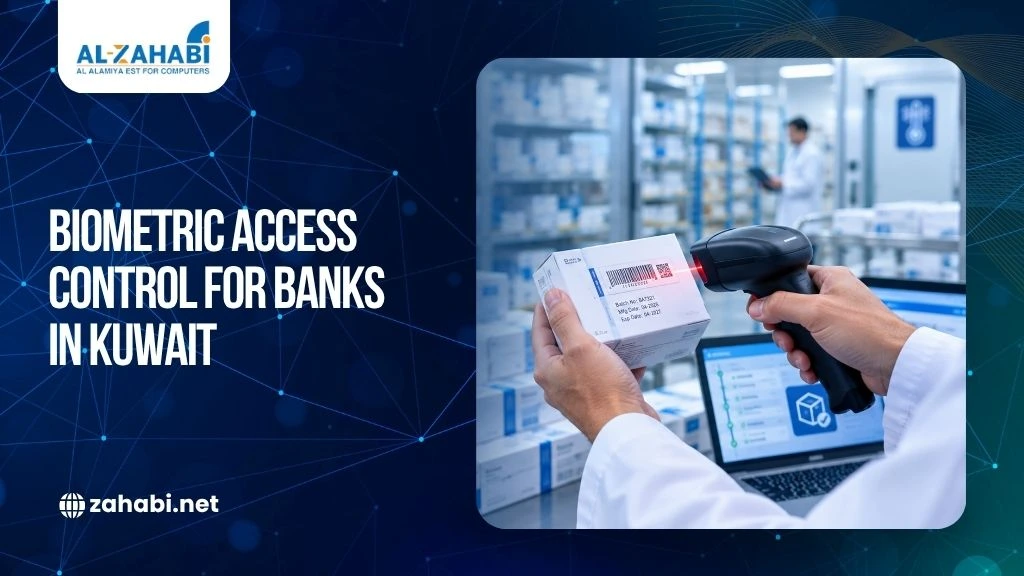
A pharmaceutical shipment can pass through several hands before it reaches a pharmacy or healthcare facility. If you cannot quickly identify which product moved, where it came from, which batch it belongs to, or when it expires, a routine inventory issue can become a serious supply-chain problem.
This is where pharmaceutical barcode traceability in Kuwait becomes important. A properly designed barcode system can connect product identification with information such as batch numbers, expiry dates, and serial numbers, allowing authorised supply-chain participants to capture data at different points in the product journey.
GS1 standards provide a common framework for identifying products and sharing traceability information. GS1 Kuwait specifically describes GTIN, GLN, barcodes, EPC/RFID, and EPCIS as components that can support interoperable traceability systems.
For pharmaceutical distributors, the goal is simple: make every scan useful, accurate, and connected to the right product information.
Key Takeaways:
- Pharmaceutical barcode traceability connects medicines with important product data.
- GS1 standards provide a common framework for identifying and tracking healthcare products.
- GS1 DataMatrix can encode GTIN, batch, expiry, and serialisation data.
- Good printing and scanning are essential for reliable traceability.
- Your barcode system should match regulatory, operational, and trading-partner requirements.
What Pharmaceutical Barcode Traceability Means
Pharmaceutical barcode traceability is the ability to identify and follow a medicine through different stages of its supply chain.
Instead of treating a barcode as simply a product number, a traceability system can connect the product with additional information such as its batch or lot number, expiry date, and unique serial number.
GS1 describes these identification keys and attributes as part of the foundation for healthcare traceability. Its healthcare traceability guidance shows how pharmaceutical products can be identified at packaging levels and linked to information in product databases.
This matters when you need to answer practical questions quickly.
- Which product was received?
- Which batch was shipped?
- When does it expire?
- Which shipment contained a particular item?
A traceable barcode system makes these questions easier to answer when the underlying systems and processes are properly connected.
Why Traceability Matters in Pharmaceutical Distribution
Pharmaceutical distribution leaves little room for uncertainty.
A distributor may handle large numbers of products with different strengths, pack sizes, batches, and expiry dates. Manual identification can make these processes slower and increase the risk of data-entry mistakes.
Barcode scanning provides a more consistent way to capture product information.
For example, a warehouse employee receiving a shipment can scan the product rather than manually entering a long identification number. If the barcode carries additional GS1 information, the scan can also capture relevant attributes supported by the system.
This becomes particularly valuable when inventory needs to be checked, transferred, recalled, or reconciled.
Related barcode solutions for healthcare facilities can also support consistent identification and data capture across healthcare-related inventory workflows.
Supporting Faster Product Identification
A barcode gives the scanner a machine-readable representation of product identification data.
GS1 explains that a GTIN identifies the trade item, while additional information can be associated with the product through GS1 Application Identifiers.
This creates a structured way to capture information across supply-chain processes.
For a pharmaceutical distributor, that can mean fewer manual steps during receiving, picking, dispatch, and inventory checks.
GS1 Pharma Labeling and Product Identification
GS1 pharma labeling is built around standardised product identification and data capture.
A GTIN can identify the pharmaceutical product, while additional attributes can provide information such as batch/lot number, expiry date, and serial number where applicable.
Understanding GS1 barcode standards for Kuwait businesses can help pharmaceutical distributors apply consistent product identification practices across their supply-chain operations.
The exact data requirements depend on the application and relevant regulatory or trading-partner requirements.
This distinction is important. A barcode should not simply contain as much information as possible. It should contain the information required for the specific use case, encoded using an appropriate GS1 structure.
For example, GS1 Application Identifiers provide a standardised way to interpret information such as GTIN, batch numbers, expiry dates, and serial numbers.
That common structure helps different parties interpret the data consistently.
GS1 DataMatrix for Pharmaceutical Applications
For healthcare applications requiring multiple data elements in a compact space, GS1 DataMatrix is particularly relevant.
GS1 Healthcare identifies GS1 DataMatrix as a preferred data carrier for healthcare product identification and traceability. It can contain a GTIN along with information such as batch/lot number, expiry date, and unique serial number.
This is useful for pharmaceutical packaging because available label space can be limited.
A traditional linear barcode may identify a product effectively, but a 2D barcode can accommodate additional structured information in a relatively small area.
GS1’s guidance also notes that DataMatrix provides error detection and correction capabilities, which can help maintain readability when labels experience certain types of physical damage.
However, choosing a barcode should always depend on the actual application, packaging, scanning environment, and applicable requirements.
How a Drug Traceability Barcode System Works
A drug traceability barcode system generally involves more than printing a barcode on a medicine pack.
The process starts with product identification.
A manufacturer or brand owner assigns the appropriate identification number. Product information is then associated with that identifier in the relevant database or business system.
The barcode is printed on the product packaging.
As the product moves through distribution, authorised personnel can scan it at relevant checkpoints.
The captured information can then be connected with inventory or traceability records.
A simplified flow looks like this:
Product identification → Barcode creation → Printing → Receiving → Storage → Picking → Dispatch → Delivery/Dispensing
The value comes from connecting these individual scans to reliable records.
From Manufacturer to Distributor
Consider a pharmaceutical manufacturer sending a batch of medicine to a distributor in Kuwait.
At the manufacturing stage, the product is assigned its identification information. The relevant barcode is printed on the packaging.
When the distributor receives the shipment, warehouse personnel scan the products or logistics units according to the operating process.
The system can associate the scan with the corresponding product record.
Later, when the same stock is picked for an order, another scan can update the inventory movement.
This creates a digital trail of product movements.
GS1’s healthcare traceability example similarly demonstrates how pharmaceutical products can be identified at different packaging levels and connected to information such as GTIN, batch, and expiry data.
Barcode Printing Quality Can Make or Break Traceability
A compliant barcode is only useful if scanners can read it consistently.
This makes Barcode Printing an important part of pharmaceutical traceability.
Poor print quality, unsuitable labels, incorrect dimensions, damaged symbols, or inadequate contrast can create scanning problems.
For pharmaceutical operations, those failures can cause more than a minor inconvenience. They can slow receiving, picking, inventory verification, and dispatch processes.
Your printing setup should therefore be selected around the actual label requirements and operating environment.
Choosing the Right Printer
A high-volume pharmaceutical distributor may need equipment designed for continuous barcode printing, while a smaller operation may have different requirements.
The important factors include:
- Expected print volume
- Label dimensions
- Required resolution
- Label material
- Printing method
- Operating environment
- Integration with existing systems
Comparing thermal vs inkjet barcode printers can help pharmaceutical distributors select a printing method that matches their label material, print volume, resolution, and operating requirements.
A dedicated barcode printer can provide more consistent output than relying on general office printing equipment.
If your operation prints large numbers of labels, printer selection should be treated as part of the traceability workflow rather than as a separate purchasing decision.
Barcode Labels Must Survive the Supply Chain
The barcode is likely to be handled, stored, transported, and scanned multiple times.
That means Barcode Labels need to match the environment in which they will be used.
A label for an outer shipping carton has different practical requirements from a small label applied directly to pharmaceutical packaging.
You should consider exposure to handling, storage conditions, abrasion, and the expected lifespan of the label. Printing technology also matters.
Thermal transfer printing, for example, uses a ribbon to transfer the image onto the label material and can be appropriate when durable printed information is required.
The correct combination of printer, media, and ribbon helps maintain barcode readability throughout the product journey.
Scanning Equipment Is Part of the Traceability System
Printing a good barcode is only half the process. Understanding different barcode scanner types for pharmaceutical operations can help distributors select scanning equipment that matches their barcode formats and warehouse workflows.
Your distribution team also needs scanning equipment that can reliably capture the barcode during everyday operations.
Mobile Computer devices can be especially useful in pharmaceutical warehouses because employees can scan products while simultaneously accessing inventory or warehouse-management information.
For example, a picker can scan an item, confirm the product and quantity, and record the movement without returning to a fixed workstation.
This can make the workflow more practical in large storage areas.
Depending on your environment, handheld or wireless scanning equipment may also provide greater mobility during receiving, picking, and dispatch.
Where POS and Kiosks Fit Into Pharmaceutical Operations
Not every pharmaceutical traceability workflow happens inside a warehouse.
Retail pharmacies and healthcare facilities may use point-of-sale or self-service technologies alongside their inventory systems.
A POS Machine can use barcode scanning to identify products during a transaction, while POS Accessories can support the surrounding checkout workflow.
In environments where customers or staff need to locate product information, a Price Checker Kios may also be part of the broader retail technology environment.
These systems are not substitutes for a pharmaceutical traceability platform. Instead, they can become additional points where product identification data is captured or displayed.
The important consideration is integration.
If your systems cannot exchange or interpret the relevant product information correctly, adding more scanning points will not automatically create better traceability.
Traceability Requires More Than Barcodes
A barcode cannot create traceability on its own. You need the processes and systems behind it.
GS1 Kuwait explains that its traceability framework uses identification standards such as GTIN and GLN, along with barcodes and EPC/RFID data capture standards. It also identifies EPCIS as an important component for sharing information about the physical movement and status of products across supply chains.
That means a traceability project should consider both physical identification and digital information flow.
The barcode identifies the item.
The scanning event captures the data.
The business system records what happened.
The traceability infrastructure connects those events into useful information.
This distinction is important when planning a new system.
Barcode Traceability and RFID
Some pharmaceutical and healthcare operations may eventually combine barcode identification with RFID.
GS1 Kuwait identifies both barcodes and EPC-enabled RFID tags as data-capture technologies that can support traceability.
RFID can be useful where automated identification and movement tracking provide operational value.
Comparing RFID vs barcode inventory tracking technologies can help distributors determine whether barcode scanning, RFID, or a combination of both is better suited to their operational requirements.
However, that does not mean every pharmaceutical distributor needs to replace barcodes with RFID.
For many workflows, barcode scanning remains practical, familiar, and cost-effective.
A business can evaluate RFID Solutions when it has a specific requirement that justifies the technology, such as greater automation or improved visibility across particular logistics processes.
The right approach depends on the warehouse, product flow, required data, and integration capabilities.
Building a Reliable Traceability Workflow in Kuwait
If you are planning pharmaceutical barcode traceability in Kuwait, start with the process rather than the equipment.
First, map where products enter your operation and where they leave it.
Then identify the points where product, batch, expiry, and serialisation information needs to be captured.
Next, determine which GS1 identifiers and barcode formats apply to your products and workflows.
After that, select compatible printers, labels, scanners, and software.
Finally, test the complete process before deploying it across the operation.
This approach helps prevent a common mistake: buying hardware first and discovering later that the equipment or software does not support the required workflow.
Practical Checks Before Implementation
Before introducing a new traceability system, review these areas:
- Product Identification: Confirm that every product and relevant packaging level has the appropriate identification.
- Data Requirements: Determine which attributes need to be captured, such as batch, expiry, or serial number, based on your applicable requirements.
- Printing: Test the barcode on the actual packaging or label material rather than assuming a sample will perform identically.
- Scanning: Test the barcode using the scanners that your warehouse or pharmacy staff will actually use.
- Software Integration: Make sure scans can reach the inventory, warehouse, ERP, or traceability system that needs the information.
- Staff Workflow: Train employees on when and where scanning should happen.
A technically correct barcode can still fail operationally if employees do not know which event they are expected to record.
The Business Value of Better Traceability
Traceability isn’t simply about adding more scans to your workflow. It is to make product information easier to capture, verify, and use.
A well-designed system can support faster product identification, better inventory visibility, more consistent data capture, and stronger control over product movements.
It can also make it easier to investigate a specific batch or product when a supply-chain issue occurs.
For a pharmaceutical distributor, that visibility can be valuable because inventory decisions often depend on product identity, batch information, expiry, and movement history.
If you are reviewing your current pharmaceutical barcode workflow, start by identifying where manual entry or unclear product identification is slowing your team down. From there, you can determine whether improved barcode printing, scanning, mobile computing, or system integration would provide the greatest benefit.
Conclusion
Pharmaceutical barcode traceability in Kuwait is ultimately about creating a reliable connection between a physical medicine and its associated information. GS1 standards provide the common identification framework, while appropriate barcode printing, scanning equipment, software, and operating processes turn that framework into a working traceability system.
For pharmaceutical distributors, the best solution is not necessarily the most complex one. It is the one that accurately captures the data you need, works with your existing operations, and can scale as your distribution requirements grow.
Frequently Asked Questions
1. What is pharmaceutical barcode traceability?
Pharmaceutical barcode traceability uses standardised product identification and scanning to track medicines through relevant supply-chain stages. Depending on the application, barcode data can include product, batch, expiry, and serialisation information.
2. What is GS1 pharma labeling?
GS1 pharma labeling uses GS1 identification and data-carrier standards to represent pharmaceutical product information in a structured, machine-readable format. GS1 DataMatrix is widely used in healthcare applications where multiple data elements need to be encoded in a compact symbol.
3. What information can a pharmaceutical barcode contain?
Depending on the application, a GS1 barcode can encode a GTIN and additional attributes such as batch or lot number, expiry date, and serial number. The exact combination depends on the applicable requirements and use case.
4. Do pharmaceutical distributors need barcode scanners?
A traceability workflow generally needs reliable data capture, making suitable barcode scanners important for receiving, inventory, picking, dispatch, and other relevant processes. The appropriate device depends on the warehouse environment and workflow.
5. Can RFID be used with pharmaceutical barcode systems?
Yes. Barcodes and EPC/RFID can be used as complementary data-capture technologies. Whether RFID adds value depends on your distribution workflow, automation requirements, integration needs, and business case.