
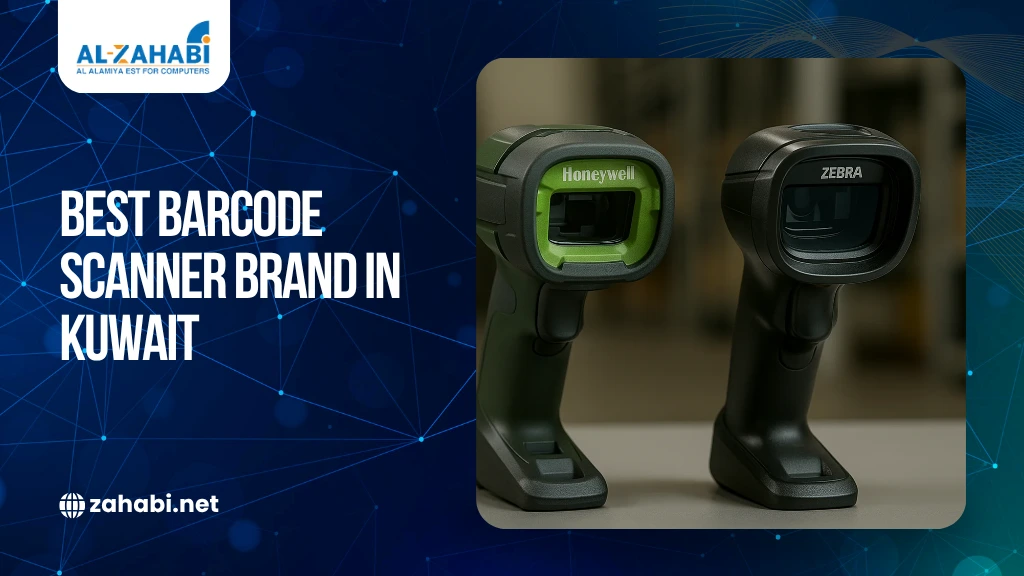
Choosing between Honeywell and Zebra barcode scanners is rarely about brand preference alone. It is a decision that affects billing speed, inventory accuracy, staff productivity, and how smoothly your operations run during peak hours.
In Kuwait, where retail stores handle high customer volumes, and warehouses operate under demanding conditions, scanners are used continuously for long shifts. Heat, dust, and heavy usage expose weaknesses in devices very quickly. This makes it important to evaluate not just features, but how each scanner performs in real working environments.
This guide takes a detailed look at both brands, comparing performance, durability, use cases, and long-term value so you can identify the best barcode scanner brand for your business.
Why This Choice Matters More in 2026?
Retail and logistics operations in Kuwait are becoming more data-driven and time-sensitive. Businesses are moving toward:
- Faster checkout experiences with minimal waiting time
- Real-time inventory tracking across multiple locations
- Automated warehouse processes with minimal manual input
At the same time, expectations have shifted. Customers expect quick billing, and businesses expect near-zero errors in stock tracking.
A retail barcode scanner or warehouse barcode scanner is no longer a basic tool. It is a core part of your operational system. The difference between a good and a poor choice shows up in daily performance, not just technical specifications.
Brand Overview: Honeywell vs Zebra
Honeywell Barcode Scanner
A Honeywell barcode scanner is widely known for its consistent decoding performance. It performs well in situations where barcode quality is not ideal, such as damaged labels or faded prints.
Strength areas
- Strong decoding accuracy
- Reliable performance across industries
- Easy to deploy and use
Highly used in:
- Retail POS systems
- Warehousing and logistics
- Healthcare and service sectors
Honeywell scanners are often chosen for their ability to handle real-world imperfections rather than ideal conditions.
Zebra Barcode Scanner
A Zebra barcode scanner is designed for high-speed and enterprise-scale operations. It is commonly used in environments where efficiency and throughput are critical.
Strength areas
- High-speed scanning
- Advanced connectivity and features
- Rugged design for heavy-duty use
Highly used in:
- Large retail chains
- Distribution centers
- Industrial warehouses
Zebra focuses on performance under pressure, especially in high-volume operations.
Core Comparison: Honeywell vs Zebra Barcode Scanner
Feature | Honeywell Barcode Scanner | Zebra Barcode Scanner |
Scanning accuracy | Excellent for damaged labels | Very high for clean barcodes |
Speed | Consistent | Very high throughput |
Durability | Strong | Extremely rugged |
Ease of use | Simple | Advanced configuration |
Cost | Moderate | Higher upfront |
Best fit | Accuracy-focused operations | High-volume environments |
Detailed Performance Analysis
1. Barcode Reading Accuracy in Real Conditions
In practical environments, barcodes are rarely perfect. Labels may be scratched, faded, or poorly printed.
- Honeywell scanners are designed to handle these imperfections effectively
- Zebra scanners prioritize speed but also perform well with standard-quality barcodes
Example – In a warehouse where labels are exposed to dust and handling, Honeywell scanners often provide more consistent reads. In contrast, in a supermarket with clean packaging, Zebra scanners deliver faster results.
2. Speed and Checkout Efficiency
Speed becomes critical in high-traffic retail environments.
- Zebra scanners are optimized for rapid scanning with minimal delay
- Honeywell scanners provide stable performance but slightly lower speed in comparison
Operational impact
- Faster scanning reduces queues
- Higher throughput improves customer experience
- Consistent speed reduces staff fatigue
In large retail stores, even small time savings per transaction can significantly improve daily operations.
3. Durability and Build Quality
Durability is a major factor for warehouse environments.
- Zebra scanners are often built with higher drop resistance and rugged casing
- Honeywell scanners are durable but more suited for controlled environments
Comparison table
Condition | Honeywell | Zebra |
Drop resistance | Good | Excellent |
Dust resistance | Good | Very high |
Heavy-duty use | Moderate | High |
Zebra is often preferred in logistics environments where devices are exposed to rough handling and continuous use.
4. Wireless Performance and Mobility
A wireless barcode scanner is essential for mobility in warehouses and large retail spaces.
- Zebra offers a longer range and stronger connectivity stability
- Honeywell provides reliable wireless performance for standard use
Use case
- Large warehouses benefit from Zebra’s extended range
- Retail floors and smaller warehouses perform well with Honeywell
5. Battery Life and Long Shifts
Battery performance directly affects productivity.
- Zebra scanners are designed for extended usage across multiple shifts
- Honeywell scanners support standard retail and warehouse operations
Example: In a 24/7 warehouse, Zebra devices reduce charging-related downtime. In smaller operations, Honeywell provides sufficient performance without overinvestment.
6. Ease of Deployment and Staff Training
Ease of use is often overlooked but affects adoption.
- Honeywell scanners are simpler to configure and use
- Zebra scanners offer advanced features, but may require setup
Impact on business
- Faster onboarding for staff
- Reduced training time
- Fewer operational errors
Small businesses often prefer simplicity, while large enterprises value customization.
Which Barcode Scanner Works the Best for Retail Use?
Retail environments vary from small stores to large supermarkets.
Honeywell Barcode Scanner:
- Ideal for stores with moderate traffic
- Handles damaged barcodes effectively
- Cost-efficient for multiple counters
Zebra Barcode Scanner:
- Suitable for high-volume supermarkets
- Faster checkout performance
- Better for advanced POS systems
Example – A convenience store benefits from a Honeywell Voyager scanner as a reliable POS scanner. A large supermarket benefits from Zebra due to faster billing.
Which Barcode Scanner Is Better for Warehouse Operations?
Warehouse operations demand different capabilities.
Honeywell Barcode Scanner:
- Reliable for mixed inventory conditions
- Performs well with worn labels
- Suitable for medium-scale operations
Zebra Barcode Scanner:
- Long-range scanning capabilities
- Designed for heavy-duty environments
- Better for large logistics operations
Example – A distribution center handling thousands of items daily benefits from Zebra’s performance. Whereas a mid-size warehouse can operate efficiently with Honeywell.
Types of Scanners and Their Role in Retail and Warehouse Operations
Choosing between Honeywell and Zebra is only one part of the decision. The type of scanner you deploy has an equally important impact on how efficiently your operations run on a daily basis. Each scanner type is designed for a specific workflow, and selecting the wrong one can create delays, errors, and unnecessary handling effort.
Handheld Barcode Scanner: Flexibility Across Multiple Use Cases
A handheld barcode scanner is one of the most commonly used devices in both retail and warehouse environments. Its primary advantage lies in flexibility. Staff can move the scanner to the product rather than repositioning the product for scanning.
This becomes especially useful in situations where:
- Products are bulky or irregular in shape
- Barcodes are not easily accessible
- Staff need to perform inventory checks away from the billing counter
In retail, handheld scanners are often used alongside POS systems for exceptions, such as scanning large items or verifying stock. In warehouses, they are essential for picking, packing, and stock verification tasks.
While handheld scanners may not match the speed of fixed systems, their adaptability makes them a critical part of most operations.
Wireless Barcode Scanner: Mobility and Operational Efficiency
A wireless barcode scanner is designed for environments where mobility is essential. It allows staff to move freely without being restricted by cables, which improves both speed and convenience.
This is particularly valuable in:
- Large retail floors where staff assist customers
- Warehouses where items are spread across wide areas
- Inventory audits that require movement across locations
Wireless scanners also reduce clutter at workstations and improve ergonomics. However, they require stable connectivity and reliable battery performance to avoid interruptions during operations.
In large-scale warehouse environments in Kuwait, where distances between storage areas can be significant, wireless scanners often become a necessity rather than an option.
POS Scanner: Speed and Consistency at Checkout
A POS barcode scanner is designed specifically for checkout environments where speed and accuracy are critical. These scanners are optimized for high-frequency use and are built to deliver consistent performance throughout long working hours.
At the billing counter, even small delays in scanning can create queues. A POS scanner helps:
- Reduce transaction time
- Improve billing accuracy
- Maintain a steady flow of customers
In high-volume retail environments, such as supermarkets, POS scanners are essential for maintaining efficiency during peak hours. They are often used in combination with handheld scanners to handle exceptions.
Cost vs Long-Term Value: What Businesses Often Overlook
When choosing between Honeywell and Zebra, many businesses focus primarily on upfront cost. While this is understandable, it often leads to decisions that do not hold up over time.
Honeywell: Lower Entry Cost with Reliable Performance
Honeywell scanners typically offer a lower initial investment, making them suitable for businesses that want dependable performance without a high upfront cost.
They are particularly effective for:
- Small to mid-sized retail stores
- Moderate warehouse operations
- Businesses with standard scanning requirements
While the upfront savings are clear, Honeywell scanners still provide strong accuracy and consistent performance, especially in environments where barcode quality may vary.
Zebra: Higher Investment with Long-Term Operational Gains
Zebra scanners usually come with a higher upfront cost, but they are designed for environments where performance demands are significantly higher.
They are well-suited for:
- High-volume retail chains
- Large warehouses and distribution centers
- Operations that require continuous scanning
The advantage of Zebra lies in its ability to maintain speed and durability over long periods. In environments where thousands of scans are performed daily, this reliability translates into measurable operational benefits.
Understanding the Real Cost Impact
The true cost of a barcode scanner is not limited to its purchase price. It includes factors such as:
- Time taken per transaction
- Frequency of scanning errors
- Maintenance and replacement costs
- Staff productivity
A slower scanner may increase billing time, which affects customer flow. A less durable scanner may require frequent repairs, increasing downtime.
Example – A scanner that saves even 1–2 seconds per transaction can significantly improve throughput in a high-volume retail environment. Over time, this contributes to better customer experience and higher operational efficiency.
Balancing Cost and Performance
The goal is not to choose the cheapest or the most expensive option, but to select a solution that aligns with your operational scale.
- For moderate usage → Honeywell offers strong value
- For high-volume, performance-driven environments → Zebra provides better long-term returns
Businesses that evaluate cost in terms of performance and longevity are more likely to make decisions that support growth rather than limit it.
2026 Industry Update: What’s Changing in Barcode Scanning and Why It Matters
The barcode scanning industry is undergoing structural changes, especially as retail and logistics operations become more automated and data-driven.
One of the most significant news items is that Honeywell International Inc. is restructuring parts of its business. In 2026, the company announced plans to divest its Productivity Solutions and Services (PSS) unit, which includes barcode scanning and mobility solutions. This move is aimed at sharpening focus on higher-growth industrial automation segments.
At the same time, Zebra Technologies continues to expand aggressively in retail and warehouse automation. Zebra has been investing in AI-driven retail systems, real-time inventory visibility, and connected frontline worker solutions.
What Does This Mean for Businesses?
These developments are not just corporate decisions. They directly affect how businesses should evaluate technology investments.
Zebra’s Focus on Retail and Frontline Automation
Zebra’s strategy is centered around building integrated retail ecosystems. This includes scanners that work alongside:
- POS systems
- Inventory management platforms
- Real-time analytics tools
Their recent retail studies highlight that over 70% of retailers globally are increasing investments in automation and data capture technologies to improve efficiency and customer experience.
For businesses in Kuwait, this means Zebra devices are increasingly aligned with:
- Large-scale retail chains
- High-volume checkout environments
- Digitally integrated warehouse systems
Honeywell’s Strength in Industrial and Practical Applications
While restructuring, Honeywell continues to maintain a strong presence in industrial automation, logistics, and warehouse operations.
Its focus remains on:
- Reliable data capture in real-world conditions
- Scanning accuracy in challenging environments
- Integration with industrial workflow systems
This makes Honeywell particularly relevant for:
- Warehouses with mixed inventory conditions
- Operations where barcode quality is inconsistent
- Businesses that prioritize reliability over advanced features
Strategic Insight for Decision-Makers
For businesses evaluating a Honeywell vs Zebra barcode scanner, this shift highlights an important distinction:
- Zebra is increasingly positioned as a technology-driven, enterprise solution provider
- Honeywell remains a practical, reliability-focused choice for operational consistency
This does not mean one is better than the other. It means the choice should align with your operational model and future direction.
Common Mistakes When Choosing a Barcode Scanner
Many businesses underestimate the impact of scanner selection on daily operations. As a result, they make decisions that seem cost-effective initially but lead to inefficiencies over time.
Choosing based only on price
Focusing only on upfront cost often leads to selecting devices that cannot handle real workload demands. This results in slower operations and higher maintenance costs.
Ignoring the real usage environment
Scanners perform differently in controlled retail spaces compared to dusty or high-traffic warehouse environments. Choosing without considering actual usage conditions can lead to performance issues.
Not considering future scalability
As businesses grow, transaction volumes and operational complexity increase. A scanner that works today may not support future requirements, leading to early replacement.
Overlooking integration with POS systems
A scanner must work seamlessly with your POS or warehouse system. Poor integration can cause delays, errors, and inefficiencies during daily operations.
Final Verdict: Which One Should You Choose?
The choice between a Honeywell vs Zebra barcode scanner should be based on how your business operates rather than brand preference.
Choose Honeywell if:
- You need reliable decoding of damaged or inconsistent barcodes
- You want a cost-effective solution for moderate-scale operations
- Your environment requires consistent, practical performance
Choose Zebra if:
- You need high-speed scanning for large transaction volumes
- You operate in high-volume retail or large warehouse environments
- You require rugged, enterprise-grade devices with advanced capabilities
Final Thought
There is no universal answer to which brand is better. Both Honeywell and Zebra have established themselves as leaders by addressing different operational needs.
The right decision comes from understanding your workflow, environment, and long-term requirements. A scanner that aligns with your business processes will always deliver better results than one chosen based on brand alone.
In Kuwait’s evolving retail and warehouse landscape, investing in the right scanning technology is not simply about improving efficiency. It is about building a system that supports accuracy, scalability, and long-term operational stability.
FAQs
Which is better for retail in Kuwait, Honeywell or Zebra barcode scanners?
Honeywell scanners are well-suited for small to mid-sized retail stores where barcode quality may vary and ease of use is important. Zebra scanners perform better in high-volume retail environments where speed, throughput, and integration with advanced POS systems are critical.
Are Zebra barcode scanners more durable than Honeywell scanners?
Zebra scanners are generally designed with a more rugged build quality, making them suitable for heavy-duty warehouse and logistics environments. Honeywell scanners are also durable but are better suited for controlled environments with moderate usage conditions.
Which barcode scanner is better for warehouse operations?
Zebra scanners are ideal for large warehouses that require long-range scanning, high-speed performance, and continuous operation across shifts. Honeywell scanners are a strong choice for medium-scale warehouses where barcode conditions may vary, and reliability is more important than speed.
How do I choose the best barcode scanner brand for my business?
The best barcode scanner brand depends on your transaction volume, environment, and long-term operational needs rather than just price. Businesses should evaluate factors such as scanning speed, durability, integration with existing systems, and future scalability before making a decision.




Add comment