No products in the cart.

Shopping cart (0)
Subtotal: د.ك0.000
Spend د.ك3,050.000 to get free shipping
Congratulations! You've got free shipping.
Menu
Categories
- All in one terminal | Pos Machines | Zahabi
- Barcode Printing Solution
- Biometrics Attendance System
- ID Cards
- Kiosk
- Mobile Computer in Kuwait
- POS Accessories
- POS Machines
- Price Checker Kios | Pos Machines | Zahabi
- RECEIPT PRINTER
- RFID & Hardware Solutions
- Uncategorized
ZAHABI
How RFID Printers Improve Inventory Accuracy in Retail & Warehousing?
- By Zahabi
Inventory looks accurate on paper, but does it always match what is actually on the shelf or in the warehouse? Many retailers and warehouse operators discover gaps during audits, cycle counts, or stock checks. Even with barcode systems in place, items still get misplaced, counts fall out of sync, and visibility weakens over time. Inventory accuracy remains one of the most persistent operational challenges.
When these gaps become frequent, businesses start exploring RFID printers for inventory management. RFID allows items to be identified and read automatically, often in bulk, without line-of-sight scanning.
This guide explains how RFID printers support more accurate inventory tracking, how they work within an RFID system, and what retailers and warehouse operators should plan before adopting the technology.
Why Inventory Accuracy Fails in Barcode-Based Systems?
Barcode systems require line-of-sight scanning. Each item must be scanned individually. This creates operational friction in high-volume environments.
Common barcode-related accuracy problems include:
- Missed scans during receiving
- Human error during manual cycle counts
- Duplicate entries
- Incorrect shelf placement
- Delayed stock updates
In retail environments, this leads to out-of-stock issues. In warehouses, it slows picking and shipping operations.
Therefore, inventory accuracy depends heavily on human consistency.
What Role Do RFID Printers Play in Inventory Systems?
An RFID system consists of:
- RFID tags
- RFID readers
- RFID software
- RFID printers
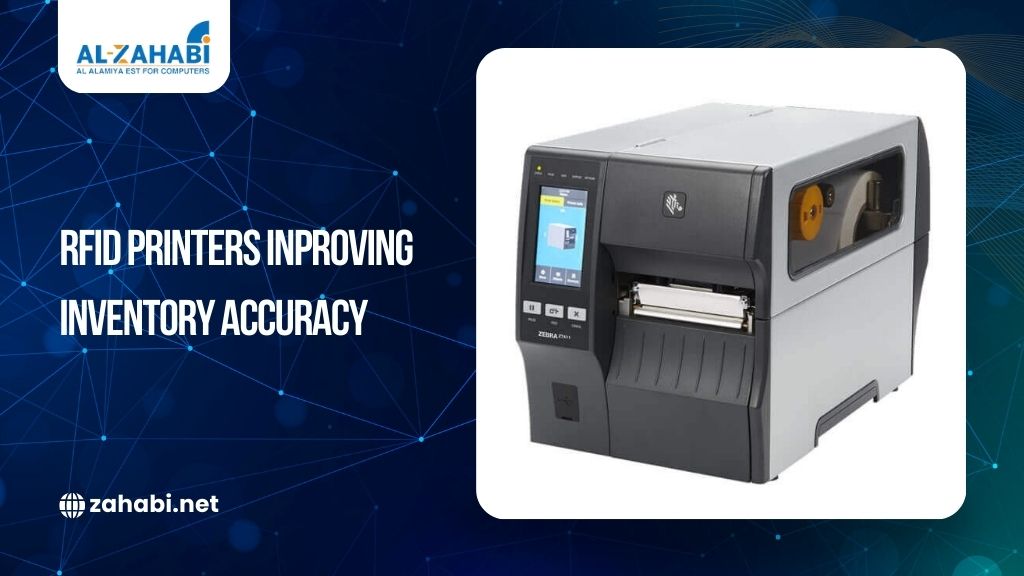
RFID printers perform two functions at once. They print the visible label and encode the RFID chip embedded inside the tag.
During printing:
- Product data is written into the chip
- The encoding is verified
- A matching barcode or text label is printed
If encoding fails, the printer flags the tag before it enters circulation. This early verification reduces downstream inventory errors. This is why RFID printers for inventory management are not optional hardware. They are foundational to data accuracy.
How RFID Standards Ensure Reliable Inventory Encoding?
RFID systems in retail and warehousing commonly follow EPC standards defined by GS1 and ISO/IEC 18000 air interface protocols. These standards regulate how RFID tags are encoded, how readers communicate with tags, and how data is structured across supply chains.
By following standardized encoding structures, businesses ensure that RFID tags remain readable across different reader brands and warehouse systems. This interoperability reduces integration errors and improves long-term system stability.
This standards-based approach strengthens inventory accuracy across large-scale deployments.
How RFID Printing Works in Practice?
RFID printers combine two processes:
- Printing human-readable and barcode information on the label
- Encoding an EPC (Electronic Product Code) into the embedded RFID chip
Most retail and warehouse deployments use UHF (Ultra High Frequency) RFID technology because it supports longer read ranges and bulk scanning.
When a label is printed:
- The printer writes product data into the RFID chip
- It verifies that encoding was successful
- It prints matching visual information
This verification step reduces labeling errors before products enter inventory.
How RFID Improves Inventory Accuracy in Retail?
Retail inventory accuracy depends on real-time stock visibility. RFID enables bulk scanning without line-of-sight requirements.
Faster Cycle Counts
With barcode systems, staff scan items individually. With RFID, entire racks can be scanned simultaneously using handheld readers.
A manual barcode cycle count that may take 6–8 staff hours can often be completed significantly faster using RFID bulk scanning.
Reduced Shrinkage and Misplacement
RFID tags can be read without line-of-sight. Items inside cartons or behind other products can still be detected.
This improves detection of misplaced items and supports stronger stock reconciliation.
Retailers implementing RFID printers for inventory management typically see improvements in:
- Stock accuracy
- Replenishment timing
- Loss prevention monitoring
How RFID Improves Inventory Accuracy in Warehousing?
Warehousing environments benefit from RFID in different ways.
Faster and More Accurate Inbound Receiving
Shipments can be scanned in bulk at dock doors. Instead of scanning cartons individually, RFID readers confirm multiple tagged items simultaneously. This, in turn, helps minimize inbound processing time and receiving errors.
Improved Picking Verification
RFID systems can verify correct item selection before shipment. This reduces picking errors and return rates.
Real-Time Inventory Movement
When readers are placed in warehouse zones, inventory movement updates automatically in the system. This reduces manual data entry and improves throughput visibility.
Barcode vs RFID Workflow
| Process Stage | Barcode Workflow | RFID Workflow |
| Receiving | Manual scanning | Bulk scanning |
| Cycle counting | Item-by-item | Shelf-level scanning |
| Picking verification | Visual + scan | Automated validation |
| Inventory updates | Human-dependent | System-triggered |
| Error risk | Moderate | Lower (with proper setup) |
This comparison explains why businesses evaluating RFID printers for inventory management often focus on workflow improvement rather than just technology.
Before and After: Barcode vs RFID Inventory Accuracy
| Workflow Stage | Barcode System | RFID System |
| Receiving | Manual scan per item | Bulk scan of multiple items |
| Cycle counting | Labor-intensive | Rapid shelf-level scanning |
| Picking validation | Visual + individual scan | Automated tag confirmation |
| Inventory visibility | Periodic updates | Near real-time visibility |
| Error dependency | Human-dependent | System-assisted |
This comparison shows why RFID reduces human error exposure and increases inventory reliability in high-volume environments.
How RFID Integrates with POS, ERP, and Warehouse Management Systems?
RFID printers do not operate independently. They must integrate with inventory management software, ERP systems, and warehouse management systems (WMS).
When a product label is printed:
- The RFID tag is encoded
- The unique identifier is stored in the ERP or WMS
- That ID connects to SKU, batch, or location data
As inventory moves through receiving, storage, picking, and shipping, RFID readers update the central system automatically. This integration reduces manual reconciliation and improves reporting accuracy.
Thus, strong integration planning is critical for successful deployment.
How RFID Printers Reduce Human Error?
Human error is one of the main causes of inventory inaccuracy. RFID reduces reliance on repetitive manual scanning.
Because RFID readers capture multiple tags at once:
- Missed scans decrease
- Duplicate entries reduce
- Manual counting time drops
However, the printer must encode tags correctly from the beginning. If encoding fails or data mismatches occur, system accuracy suffers. Therefore, high-quality RFID printing and verification are critical.
What Should Businesses Plan Before Implementing RFID?
RFID improves accuracy, but it requires planning.
Decision-makers should evaluate:
- Infrastructure readiness
- Reader placement
- Tag compatibility
- Software integration
- Data synchronization
Cost considerations include:
- RFID tag pricing
- Reader hardware
- Printer investment
- System integration
RFID delivers the strongest return in medium-to-large retail and warehouse environments with high SKU counts and frequent stock movement. Smaller operations should evaluate the cost-benefit carefully before deployment.
What ROI Can Retailers and Warehouses Expect from RFID?
RFID-related investment decisions are often driven by measurable operational gains.
Businesses typically evaluate:
- Reduction in cycle count labor hours
- Improvement in the inventory accuracy percentage
- Decrease in shrinkage
- Reduction in picking errors
For example:
- If manual cycle counts require 40 labor hours per week, and RFID reduces that by half, labor savings accumulate quickly.
- If inventory accuracy improves from 92 percent to 98 percent, stock visibility and replenishment improve significantly.
These measurable improvements often justify the investment in RFID printers for inventory management when implemented at scale.
Limitations of RFID in Retail and Warehousing
RFID is not without constraints.
Environmental factors can affect read rates. For example:
- Metal surfaces can interfere with signals
- Liquid-heavy products may reduce read rates
- Tag placement affects performance
- Infrastructure costs must be justified
In addition, RFID requires staff training and system calibration. Transparency about these realities strengthens deployment success.
Accuracy Metrics Businesses Should Track
After implementing RFID, businesses should monitor:
- Inventory accuracy percentage
- Cycle count duration
- Picking error rate
- Shrinkage rate
- Order fulfillment accuracy
These measurable indicators demonstrate whether RFID printers for inventory management are delivering expected improvements.
When Should Businesses Consider RFID Printing?
Retailers and warehouses typically consider RFID when:
- Inventory accuracy drops below acceptable levels
- Manual cycle counts consume excessive labor time
- Shrinkage becomes difficult to monitor
- Order errors increase
RFID is most effective in medium to large-scale environments with high inventory volume. For small businesses, cost-benefit analysis is essential before adoption.
Final Thoughts
RFID improves inventory accuracy by reducing dependence on manual scanning and repetitive counting. However, reliable encoding at the printing stage is critical to system performance. RFID printers ensure that every tag entering the system carries accurate, verified data.
For retail and warehousing operations seeking stronger stock visibility, RFID printers for inventory management provide a structured path toward automation. When deployed with proper integration, standards compliance, and operational planning, RFID supports measurable improvements in inventory accuracy, workflow efficiency, and supply chain reliability.
Frequently Asked Questions
1. How do RFID printers improve inventory accuracy compared to barcode printers?
RFID printers encode tags that can be read automatically and in bulk without line-of-sight scanning. This reduces missed scans and manual counting errors, which improves overall inventory accuracy.
2. Are RFID printers suitable for both retail stores and warehouses?
Yes, RFID printers are used in retail for faster cycle counts and stock visibility, and in warehouses for automated receiving and picking validation. The benefits depend on proper integration with inventory or warehouse management systems.
3. What infrastructure is required to deploy RFID printers for inventory management?
Businesses need RFID readers, compatible tags, encoding software, and integration with ERP or WMS platforms. Planning reader placement and system integration is essential for accurate data capture.
4. Do RFID printers eliminate the need for barcode labels?
Not entirely. Many businesses use hybrid labels that include both RFID encoding and printed barcodes to maintain compatibility with existing scanning workflows.
5. What factors can affect RFID read accuracy in warehouses?
Metal surfaces, liquids, tag placement, and reader positioning can influence signal performance. Proper testing and calibration help ensure reliable read rates.6. When should a business consider investing in RFID printers?
Businesses typically evaluate RFID when manual cycle counting consumes excessive labor time or when inventory discrepancies increase. RFID printers for inventory management are most effective in medium-to-large operations with high SKU volumes.

Zahabi
Topics in this article:
You may also like
How Healthcare Facilities Use Barcode & ID Printing for Patient Safety
Zahabi
March 17, 2026
ID Card Printers for Schools & Universities: What to Look For
Zahabi
March 14, 2026
POS Systems for Restaurants in Kuwait: Features That Matter Most
Zahabi
March 9, 2026
Barcode Printing Solutions for Warehouses & Logistics Companies
Zahabi
March 3, 2026
Label Types Explained: Shipping Labels vs Product Labels vs Asset Tags
Zahabi
February 24, 2026
You may also like

 by
by