No products in the cart.

Shopping cart (0)
Subtotal: د.ك0.000
Spend د.ك3,050.000 to get free shipping
Congratulations! You've got free shipping.
Menu
Categories
- All in one terminal | Pos Machines | Zahabi
- Barcode Printing Solution
- Biometrics Attendance System
- ID Cards
- Kiosk
- Mobile Computer in Kuwait
- POS Accessories
- POS Machines
- Price Checker Kios | Pos Machines | Zahabi
- RECEIPT PRINTER
- RFID & Hardware Solutions
- Uncategorized
ZAHABI
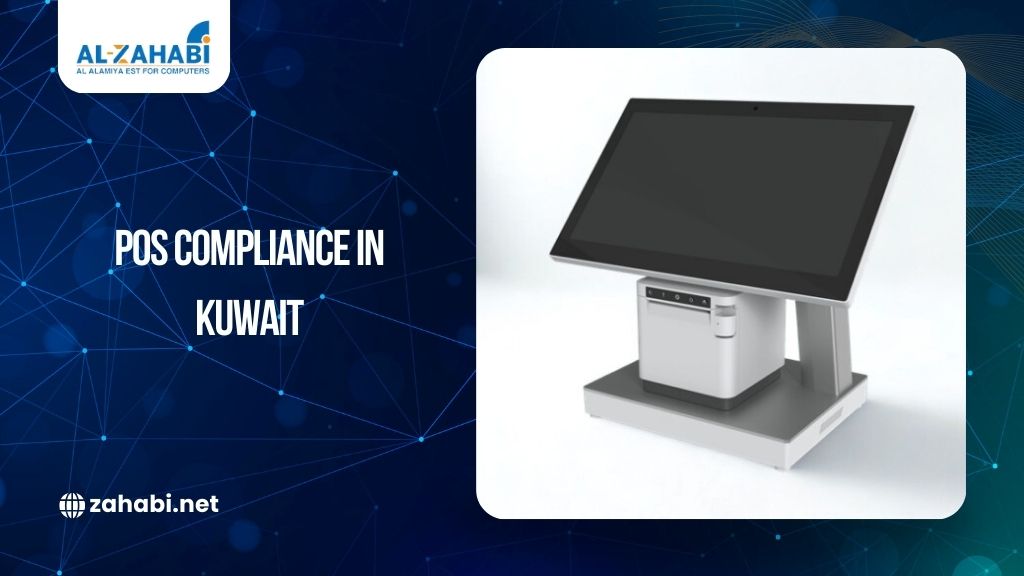
POS Compliance in Kuwait: What Retailers Need to Know
- By Zahabi
When was the last time you reviewed your POS system from a compliance perspective?
Most retailers in Kuwait focus on speed, reporting features, or pricing. Few stop to ask whether their system is legally structured for tax reporting, transaction storage, and audit readiness. That gap can become expensive.
If your system does not meet POS compliance requirements in Kuwait, the risk is not only operational. It can affect your financial reporting, regulatory standing, and business continuity.
As of 2026, financial oversight expectations aligned with GCC frameworks require retailers to maintain structured, traceable, and secure transaction systems. Your POS is central to that responsibility.
What Does POS Compliance Mean in Practical Terms?
POS compliance is about whether your system can legally support your retail operations.
Accurate Transaction Recording
Every sale must be recorded without omission. The system should prevent unauthorized deletion or editing of finalized transactions. Timestamp accuracy and user tracking are essential.
Tax Calculation and Reporting Capability
If VAT applies to your business category, the system must calculate tax automatically and consistently. Manual adjustments increase compliance risk.
Structured Financial Documentation
Invoices and receipts must follow clear formatting standards. Your POS must generate legally acceptable documentation, not just simplified billing slips.
If your system struggles in any of these areas, it may not meet POS compliance requirements in Kuwait.
Regulatory Framework: You Must Know
Retail compliance in Kuwait connects to financial oversight structures, including the Kuwait Ministry of Finance and the broader GCC Unified VAT Agreement.
GCC VAT Coordination
The GCC framework establishes shared principles for VAT calculation and documentation. Even where implementation phases vary, retailers must operate systems capable of tax-ready reporting.
Retail Record-Keeping and System Requirements
Retailers are expected to maintain structured transaction logs, secure data retention policies, and transparent invoice generation processes.
Your POS must remain adaptable to regulatory changes. A rigid system creates long-term risk.
VAT Handling: Configuration Matters
Incorrect VAT configuration is one of the most common compliance failures. Here are some of the ways to handle VAT in a correct way:
Separate Display of Taxable Value and VAT
Receipts must clearly show taxable value and VAT as separate amounts. Combining figures reduces transparency.
Automated VAT Calculation
The POS must apply correct tax rates automatically. Manual overrides weaken internal controls and increase audit exposure.
VAT Reporting and Reconciliation
Your system should generate daily and monthly VAT summaries that reconcile with accounting software.
Improper tax setup directly impacts POS compliance requirements in Kuwait.
Invoice and Receipt Structure
A receipt is not just proof of payment. It is a financial document that reflects how your business records revenue and reports taxes. During audits or regulatory reviews, receipts are often the first documents examined to verify accuracy and compliance.
Mandatory Information on Every Receipt
Each receipt should display:
- Business name
- Registration details
- Date and time
- Itemized products
- Tax breakdown
- Total payable amount
Formatting Consistency
The format should remain consistent across transactions. Incomplete or inconsistent formatting creates audit risk.
Clear documentation supports POS compliance requirements in Kuwait.
Data Retention and Transaction Storage
Can you retrieve an invoice from three years ago within minutes?
If the answer is no, your system may not be structured for regulatory readiness. Compliance is not only about recording today’s sales. It is also about preserving accurate historical data that can be accessed quickly during audits or financial reviews. Delays in retrieving records create risk and weaken your reporting credibility.
Long-Term Record Retention
Retailers are generally expected to maintain transaction records for multiple years to support regulatory review and tax verification. Your POS should store detailed sales data, including timestamps, tax breakdowns, and payment methods. Historical invoices must remain accessible in their original format without alteration.
Secure Backup and Access Control
Your POS must support encrypted backups and restricted administrative access. Only authorized personnel should be able to view or export historical records. Unauthorized edits to past transactions compromise financial integrity and may raise compliance concerns during inspection.
Strong data management reinforces POS compliance requirements in Kuwait by ensuring your records remain accurate, secure, and retrievable when needed.
Audit Readiness and Activity Logging
Compliance is tested during inspection.
Instant Report Generation
Your POS should generate:
- Daily sales reports
- Monthly summaries
- VAT breakdown reports
- Refund logs
- Historical invoices
User Activity Tracking
The system should log:
- Who processed each sale
- Who issued refunds
- Who performed voids
- When changes occurred
Traceable activity logs protect you during audit review and strengthen POS compliance requirements in Kuwait.
Payment Security and PCI-DSS Alignment
If you process card payments, compliance includes payment security.
Secure Payment Handling
Your POS should:
- Avoid storing full card numbers
- Restrict user access
- Use strong password policies
- Apply regular software updates
Alignment With International Standards
PCI-DSS defines payment security standards. While banks handle encryption at the network level, your POS configuration must not weaken security controls.
Payment data protection supports overall POS compliance requirements in Kuwait.
System Integration and Financial Accuracy
Many retailers integrate POS systems with accounting or ERP software.
Synchronization Accuracy
Integration must preserve:
- VAT breakdown
- Timestamp accuracy
- Transaction totals
Prevention of Duplicate or Altered Records
Once finalized, records should not be editable without clear audit logs.
Clean integration protects financial reporting integrity and supports POS compliance requirements in Kuwait.
What Internal Controls Should You Have in Place?
Even compliant software fails without discipline. A properly configured system still depends on how your team uses it.
Access Management
Assign unique login credentials to each employee. Do not allow shared passwords. Administrative privileges should be limited to trusted personnel only. When access is controlled, transaction records remain more secure and traceable.
Monitoring Refunds and Voids
Refunds and voids should not go unchecked. Review these reports regularly to identify unusual patterns or repeated adjustments. Clear oversight reduces the risk of misuse and strengthens financial accuracy.
Internal controls are an important part of maintaining POS compliance requirements in Kuwait.
Regulatory Updates and System Flexibility
Tax rules and reporting standards evolve.
Software Updates and Patch Management
Your vendor should provide:
- Tax configuration updates
- Security patches
- Regulatory alignment upgrades
Future-Proof Configuration
A system that cannot adapt becomes risky over time.
Ongoing updates ensure continued alignment with POS compliance requirements in Kuwait.
Common Compliance Gaps
Retailers often overlook:
- Imported systems without local tax configuration
- Disabled VAT display
- Weak password controls
- Incomplete transaction logs
- Lack of structured backups
Periodic review prevents minor configuration issues from becoming compliance failures.
Practical Compliance Checklist
Before confirming your POS system, verify:
- VAT is configured correctly
- Tax appears separately on receipts
- Multi-year transaction history is accessible
- Refund logs are enabled
- Card data is secured
- User permissions are controlled
- Reports are exportable
- Updates are active
If these elements are missing, your system may not fully support POS compliance requirements in Kuwait.
Final Thoughts
Your POS system is part of your financial control structure. It must calculate tax accurately, generate compliant invoices, retain transaction records securely, protect payment data, and remain audit-ready.
Understanding POS compliance requirements in Kuwait helps you reduce regulatory risk and operate confidently.
Compliance should not be addressed only during inspection. It should be built into your system from the beginning and reviewed regularly.
Frequently Asked Questions
1. What are the main POS compliance requirements in Kuwait?
The main compliance requirements for POS include accurate transaction recording, proper VAT calculation (when applicable), structured invoice formatting, secure data retention, and audit-ready reporting. Your POS must also protect payment data and restrict unauthorized access.
2. Does my POS system need to support VAT in Kuwait?
If VAT applies to your business category, your POS must calculate VAT automatically and display it clearly on receipts. Even if VAT is not currently active for your sector, your system should be capable of supporting tax configuration in case regulations expand.
3. How long should retail POS records be stored in Kuwait?
Retailers are generally expected to retain transaction records for multiple years to support audits and tax reviews. Your POS system should allow long-term data storage, secure backups, and easy retrieval of historical invoices.
4. Can I use an imported POS system in Kuwait?
You can use an imported system, but it must be properly configured to meet local tax formatting, reporting, and record-keeping expectations. If the system cannot support POS compliance requirements in Kuwait, it may create regulatory risk.
5. What happens if my POS system is not compliant?
Non-compliance can lead to financial penalties, tax reassessments, administrative reviews, or reporting complications. Even small configuration errors in VAT display or transaction logging can trigger inspection issues.
6. How can I check if my POS system is compliant?
You should review VAT configuration, receipt formatting, transaction logging, data retention settings, payment security controls, and report generation capabilities. Testing audit reports and confirming update support from your vendor helps ensure ongoing compliance.

Zahabi
Topics in this article:
You may also like
How Healthcare Facilities Use Barcode & ID Printing for Patient Safety
Zahabi
March 17, 2026
ID Card Printers for Schools & Universities: What to Look For
Zahabi
March 14, 2026
POS Systems for Restaurants in Kuwait: Features That Matter Most
Zahabi
March 9, 2026
Barcode Printing Solutions for Warehouses & Logistics Companies
Zahabi
March 3, 2026
Label Types Explained: Shipping Labels vs Product Labels vs Asset Tags
Zahabi
February 24, 2026
You may also like

 by
by