
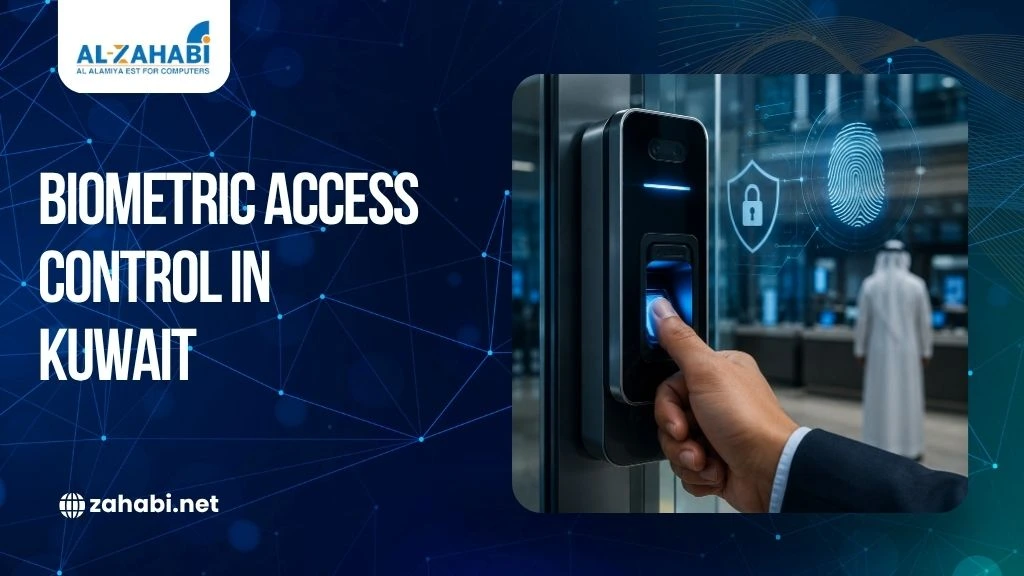
When you manage a bank or financial institution, controlling who can enter restricted areas is not a simple matter of installing a door reader. You need to protect sensitive information, employee-only spaces, server rooms, cash-handling areas, and other controlled zones without creating unnecessary friction for authorised staff.
This is where biometric access control for banks in Kuwait can play an important role. Fingerprints and facial recognition can verify a person’s identity using a biometric characteristic rather than relying only on a card or PIN.
However, biometric security also creates another responsibility: protecting the biometric data itself. Kuwait’s regulatory environment includes data privacy requirements, while the Central Bank of Kuwait (CBK) has strengthened its focus on cyber and operational resilience for regulated financial entities.
For a financial institution, the goal is therefore not simply stronger access control. It is secure, controlled, auditable, and properly governed access.
Key Takeaways:
- Biometrics can strengthen identity verification at restricted financial facilities.
- Fingerprint and face recognition systems can work alongside cards and PINs.
- Biometric data requires careful privacy and security controls in Kuwait.
- CBK’s cyber and operational resilience framework raises the importance of secure systems.
- Access control should be designed around risk, location, users, and business continuity.
Why Financial Institutions Need Stronger Access Control
Banks operate environments where physical access and information security are closely connected. Employees may need to enter offices, cash areas, data rooms, document storage areas, or other restricted locations depending on their responsibilities.
A conventional card reader can verify that a card is authorised, but it does not necessarily establish that the person presenting the card is its legitimate holder. A misplaced or shared credential can therefore create a security concern.
The Biometric Attendance System adds another verification factor based on a person’s physical characteristics. A fingerprint access control system, for example, can verify an enrolled fingerprint before allowing entry.
For higher-risk areas, you can also combine biometrics with an access card or PIN. This creates a layered approach rather than depending on a single credential.
The Central Bank of Kuwait’s current Cyber and Operational Resilience Framework reflects a broader regulatory emphasis on the ability of regulated entities to prevent, withstand, respond to, recover from, and adapt to disruptions.
Physical access controls should therefore form part of a wider security and resilience programme rather than operate as an isolated system.
How Biometric Access Control Works in a Bank
A biometric access system typically follows four basic stages: enrollment, authentication, access decision, and event logging.
During enrolment, an authorised employee’s biometric characteristic is registered in the system. Depending on the technology, this may involve a fingerprint or facial template.
When the employee approaches a secured entrance, the terminal captures a new biometric sample and compares it with the enrolled information. If the verification succeeds and the user has permission for that location, the system can trigger the door controller.
The access event can then be recorded for monitoring and auditing.
Modern systems can also combine biometric verification with other credentials. For example, ZKTeco‘s X100 and X101 fingerprint terminals support fingerprint verification, RFID card reading, PIN codes, and Wiegand connectivity.
This type of multi-method architecture can be useful when a financial institution needs different authentication policies for different areas.
Fingerprint and Face Recognition Options
Here are some options:
1. Fingerprint Access for Controlled Areas
A fingerprint system is a practical option when you need reliable employee identification at a fixed entry point.
It can be used for staff-only doors, internal departments, restricted rooms, and time-and-attendance applications. Fingerprint terminals can also support existing access control infrastructure when the required interfaces are available.
For example, ZKTeco’s F35 uses fingerprint verification and can also operate as a time-and-attendance terminal when integrated with ZKBioTime software.
This makes fingerprint technology useful when access control and employee attendance need to be managed within a connected environment.
2. Face Recognition for Contactless Verification
A face recognition access control in Kuwait setup uses a camera-based terminal to verify an authorised person’s facial characteristics.
This can be useful where you want a contactless authentication experience or need to process employees quickly at an entrance.
However, facial recognition requires careful attention to camera placement, lighting, system configuration, privacy, and fallback authentication. Understanding face recognition vs fingerprint systems can help financial institutions decide which biometric technology better suits their security and operational requirements.
A face terminal should not be selected simply because it looks more advanced. You should first establish the security requirement, operating environment, and data-handling model.
Where Biometrics Can Be Used Inside a Bank
Biometric access does not have to be applied uniformly across an entire facility.
A risk-based approach can make more sense.
Public areas may only require conventional visitor management. Employee entrances could use cards or biometrics. Higher-risk rooms may require biometric verification combined with another credential.
Potential applications include:
- Server and network rooms
- Cash-handling areas
- Records and document rooms
- Restricted employee zones
- Security control rooms
- Administrative areas
- Staff attendance points
For example, a bank may use a card reader at a general employee entrance but require fingerprint verification for a server room. This approach lets you match authentication strength to the sensitivity of the location.
Biometrics and Employee Attendance Systems
Access control and attendance are related but should not automatically be treated as the same function.
A biometrics attendance system records employee attendance events, while an access control system determines whether a person is permitted to enter a particular area.
You may use a face attendance system at a staff entrance while using a separate biometric access terminal for restricted rooms.
Similarly, a finger attendance system can record clock-in and clock-out events without giving an employee unrestricted access to every part of the building.
This distinction matters because access permissions and attendance policies may have different business and security requirements.
ZKTeco provides both access-control and time-and-attendance product categories, and its ZKBio CVAccess platform is designed to support personnel management, access control, time and attendance, and related security functions.
Privacy Considerations for Biometric Data in Kuwait
The biggest difference between a biometric system and a conventional card system is the nature of the information being processed.
A lost access card can be replaced. Biometric characteristics require much more careful handling.
Kuwait’s Data Privacy Protection Regulation treats personal data broadly and specifically includes personal fingerprints and genetic fingerprints within its definition of personal data. The current CITRA regulation was issued under Resolution No. 26 of 2024, which replaced the earlier 2021 regulation.
For a financial institution, this means biometric deployment should be considered alongside privacy governance.
Before implementation, you should establish:
- What biometric information is collected
- Why it is being collected
- Where it is stored
- Who can access it
- How long it is retained
- How it is protected
- What happens when an employee leaves
CITRA’s published privacy framework also emphasises transparency, consent, data security, and controls around personal-data processing.
Because financial institutions operate under additional regulatory oversight, your compliance, legal, information-security, and IT teams should review the specific requirements applicable to your institution before deployment.
Bank Security Compliance and Biometric Systems
Bank security compliance biometrics should not be treated as a standalone checklist.
The system needs to fit into your broader cybersecurity, physical-security, access-management, and operational-resilience controls.
The CBK’s current framework replaced the earlier 2020 cybersecurity framework with a resilience-first and maturity-oriented model. It is intended for regulated entities within Kuwait’s banking and financial ecosystem.
That makes system governance important.
You should document who administers the biometric system, who can change access permissions, how access events are monitored, and how security incidents are handled.
A bank should also consider what happens if the biometric terminal, network, power supply, or central management platform becomes unavailable.
Security should not depend on a single device working perfectly at all times.
Integrating Biometrics with Cards and Existing Systems
Replacing every existing access-control component is not always necessary.
A financial institution may already have card-based access using RFID credentials. Comparing RFID vs barcode identification technologies can also help organisations understand how different credential technologies support identification and tracking requirements. Instead of removing that infrastructure, you can evaluate biometric readers that support multiple authentication methods.
For example, ZKTeco’s X100 and X101 support fingerprint, RFID card, and PIN authentication, while also providing Wiegand connectivity for integration with access-control systems.
This can help create a phased upgrade path.
You might continue using cards for general access while introducing biometrics at higher-risk doors.
This approach can reduce disruption and allow your security team to test the technology before expanding deployment.
Choosing a Biometric System for a Financial Institution
The right system should be selected based on your risk profile rather than a feature list.
Start by identifying which areas actually require biometric authentication. Then determine the number of users, authentication methods, access schedules, and integration requirements.
You should also evaluate:
- Authentication Methods
Look for systems that support the authentication methods appropriate to your risk level. Fingerprint, face, RFID cards, PINs, and combinations of these methods may all have a place within a financial facility.
- Integration
Check whether the terminal can connect with your existing access-control software, door controllers, attendance platform, and security infrastructure. Financial institutions should also review ID card printer buying considerations when physical access cards form part of a broader authentication system.
- Data Protection
Ask how biometric templates are stored, transmitted, protected, backed up, and deleted. Your security team should understand the complete data lifecycle before approving deployment.
- Reliability and Environment
A terminal installed at a busy employee entrance has different requirements from one installed in a controlled server room.
For example, ZKTeco’s F34 has an IP65 ingress protection rating and supports on-premise and cloud-based software options, illustrating how device specifications can vary depending on deployment requirements.
- Fallback Access
A good access strategy should account for legitimate failures. You should establish an approved fallback method for situations such as a device fault, connectivity failure, or unsuccessful biometric verification.
Conclusion
Biometric access control for banks in Kuwait can strengthen physical security when it is implemented as part of a wider access-management and resilience strategy. Fingerprint and facial recognition can complement cards and PINs, while attendance systems can help manage employee time separately from restricted-area access.
However, biometric technology also introduces privacy and data-security responsibilities. Kuwait’s data-protection framework and the CBK’s cyber and operational resilience requirements make governance, secure data handling, integration, and business continuity important considerations.
The right approach is to match authentication strength to risk, protect biometric information throughout its lifecycle, and test the complete system before expanding it across the institution.
Frequently Asked Questions
1. Is biometric access control suitable for banks in Kuwait?
Lorem i.psum dolor sit amet, consectetur adipiscing elit. Ut elit tellus, luctus nec ullamcorper mattis, pulvinar dapibus leo
2. Is fingerprint or face recognition better for bank access?
Neither is universally better. The choice depends on the location, risk level, user experience, environment, and required integration.
3. Can biometrics work with a card reader?
Yes. Some access terminals support biometric verification alongside RFID cards and PINs, allowing organisations to use multiple authentication methods.
4. Does biometric attendance replace an access control system?
No. Attendance records employee time, while access control determines permission to enter specific areas. They can, however, be integrated into a broader system.
5. What should banks consider before installing biometric systems?
Banks should review authentication, privacy, biometric-data protection, integration, access permissions, system reliability, audit logs, and fallback procedures before deployment.
Add comment