
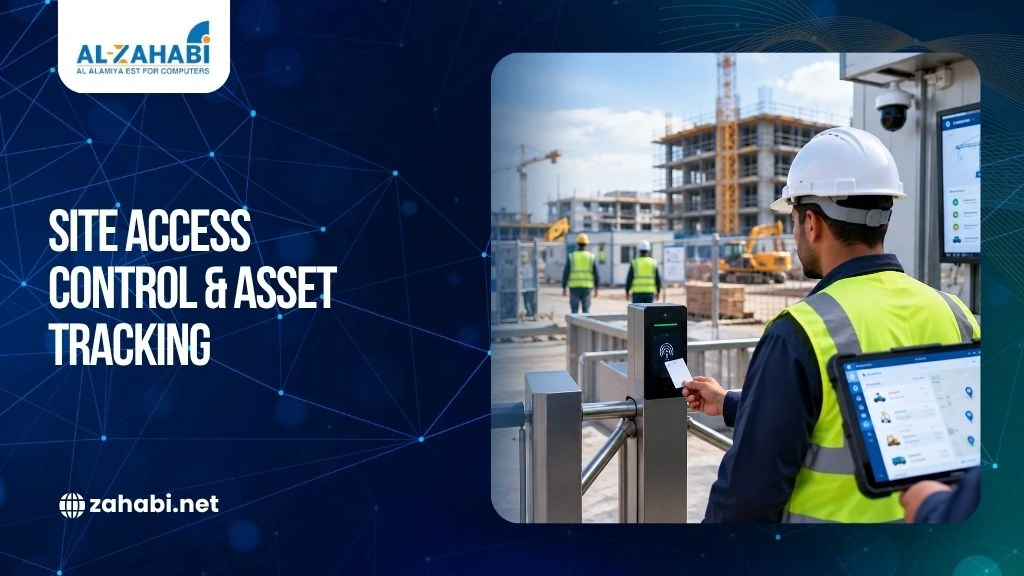
Construction sites change every day. Workers rotate between shifts, subcontractors arrive at different times, equipment moves between work zones, and valuable tools can be spread across a large project. When access records and asset locations are managed manually, it becomes difficult to know who is on-site, who is authorised to enter restricted areas, and where important equipment was last recorded.
Construction site access control in Kuwait can bring these processes into a more controlled workflow. Digital identification, access credentials, barcode scanning, rugged mobile computers, and RFID technology can help construction teams capture information at the point where work happens.
The goal is not simply to put a gate at the entrance. It is to create a reliable record of people, equipment, and movements while keeping the system practical for demanding construction environments.
Key Takeaways:
- Access control helps construction teams verify who enters and leaves the site.
- Digital ID cards can make worker and visitor identification easier.
- Rugged mobile computers support real-time asset and inventory updates.
- Barcode and RFID technologies can improve construction asset visibility.
- The right system should match the project’s size, workflow, and site conditions.
Why Construction Sites Need Better Access Control
A construction site rarely has a fixed workforce. General contractors, subcontractors, suppliers, inspectors, visitors, and temporary workers may all need access at different times.
That creates a basic management problem: who should be allowed inside, when, and for what purpose?
Access control can address this by creating defined entry procedures and maintaining records of site activity. The system can combine identification, credentials, access points, and software rather than relying entirely on a paper register.
The principle is also reflected in formal occupational safety and site-control requirements. In Kuwait, the Public Authority for Manpower (PAM) oversees the implementation of Labour Law No. 6 of 2010, which includes occupational safety and health requirements for employers. Article 83 requires employers to take necessary safety measures to protect workers, machinery, equipment, and materials from work hazards. PAM also enforces specific workplace safety measures, including restrictions on outdoor work during periods of extreme summer heat.
As a general international benchmark, OSHA’s site-control guidance also addresses procedures for controlling site access and registering site visitors. OSHA is a US occupational safety authority, so its guidance should be treated as a general reference rather than as a regulatory requirement for construction companies operating in Kuwait.
For a construction project, this information can also support emergency accountability. If management needs to establish who is currently on-site, a digital access record can be more useful than trying to reconstruct movements from handwritten logs.
Access Control Is More Than a Security Gate
A construction access system should support several practical requirements at once.
It can help you:
- Identify workers and visitors.
- Record entry and exit events.
- Restrict access to authorised personnel.
- Manage different site zones.
- Maintain visitor records.
- Support emergency headcounts.
- Create a record of access activity.
The exact configuration depends on the project.
A large project with several entrances and restricted work areas may need a more structured system than a small construction site with one controlled gate.
The important point is to design access around the actual movement of people and vehicles rather than installing technology without a clear workflow.
If you are planning access control for a new project, start by mapping every entrance, worker category, visitor type, and restricted zone before selecting hardware.
Using ID Cards for Worker and Visitor Identification
A practical access-control system starts with reliable identification.
Construction companies can issue ID cards to employees, contractors, and other authorised personnel. A complete ID badge system for workers and visitors can help construction companies organise identification credentials for employees, contractors, and authorised site personnel.
These cards can be used alongside compatible card readers or access-control devices to establish who is entering the site.
This is particularly useful when several subcontractors work on the same project.
Instead of asking security staff to recognise every person manually, the organisation can establish a defined identification process.
Zahabi’s ID Cards & Accessories category includes ID card printing solutions designed for employee IDs, visitor badges, and access-control cards.
A card-based system can also make changes easier to manage. When a worker leaves a project or their authorization changes, their access permissions can be updated according to the system being used.
The card itself should not be treated as the entire security solution. Access permissions, site procedures, and identity verification still need to be managed properly.
Managing Different Access Levels Across a Construction Site
Not everyone working on a project needs access to every area.
A site may contain:
- General work areas
- Equipment storage zones
- Electrical areas
- Material yards
- Plant areas
- Offices
- Restricted or high-risk zones
Access control can be structured around these differences.
For example, a worker may be authorised to enter the general construction area but not a restricted equipment zone. A subcontractor may receive access only during the period required for their work.
This approach gives the site manager greater control over who can enter particular areas.
Modern construction access systems can also connect access permissions with worker qualifications or site requirements. Some systems are designed to validate worker information before granting access and maintain records of site activity.
The technology should, however, support your established safety procedures rather than replace them.
Asset Tracking Construction Teams Can Actually Use
People are only one side of the problem.
Construction companies also have to manage tools, equipment, materials, devices, and other assets that move around the site.
This is where asset tracking in construction in Kuwait becomes useful.
Consider equipment such as:
- Power tools
- Surveying equipment
- Generators
- Ladders
- Testing devices
- Mobile devices
- Machinery
- High-value tools
If these assets are recorded manually, information can become outdated quickly.
A tool may be moved from one floor to another without the inventory record being updated. Equipment may be sent to another project and not recorded correctly. A damaged item may remain listed as available.
Digital asset tracking helps create a more current record.
Barcode Tracking for Tools and Equipment
Barcodes offer a straightforward way to identify individual assets.
A unique barcode can be assigned to a tool or equipment item. A worker can then scan it when the item is issued, returned, transferred, or inspected.
This reduces the need to type long asset numbers manually.
It also creates a more consistent record of asset movement when the scanning process is connected to the company’s inventory or asset-management software.
Zahabi’s barcode-printing offering includes desktop, industrial, and mobile barcode printers, along with barcode labels and related printing accessories for inventory and asset-tracking applications.
For construction environments, label selection matters. A barcode that becomes unreadable after repeated handling or exposure can undermine the entire tracking process.
If you are implementing barcode-based asset tracking, select the printer and label material based on where the asset will be used—not simply on the lowest initial equipment cost.
Rugged Mobile Computers for Construction Sites
A desktop computer is not practical when an employee needs to walk through a construction site and scan equipment.
When barcode scanning is central to field operations, comparing rugged barcode scanners vs standard scanners can help determine which type of equipment is better suited to the site environment.
This is where rugged mobile computers construction teams can use in the field become valuable.
A rugged mobile computer combines mobile computing with data-capture capabilities, allowing workers to access information while moving around the site.
Depending on the model and software, a worker may be able to:
- Scan an asset.
- Check equipment information.
- Record an issue or return.
- Update inventory.
- Verify an item.
- Access work-related information.
Zahabi’s Mobile Computer range includes rugged handheld devices from brands such as Zebra and Point Mobile, designed for demanding environments and equipped for barcode scanning and wireless connectivity.
The advantage is practical: information can be captured where the work happens instead of being written down and entered later.
That can reduce the gap between physical activity and the digital record.
Why Ruggedness Matters on a Construction Site
Construction environments are harder on electronics than a typical office. Understanding what makes devices rugged for harsh work environments can help construction companies select mobile hardware that matches the conditions their workers actually face.
Devices may be exposed to dust, accidental drops, temperature changes, vibration, and frequent handling.
That does not mean every project needs the most rugged device available.
Instead, assess the actual working environment.
Ask:
- Will workers carry the device all day?
- Will it be used indoors and outdoors?
- Will scanning happen with gloves?
- Is the device likely to be dropped?
- How important is battery life?
- Does the project require constant wireless connectivity?
These questions help determine the appropriate device specification.
The objective is to avoid two common mistakes: buying equipment that cannot withstand the environment or paying for capabilities the project does not actually need.
RFID for Large-Scale Construction Asset Tracking
Barcodes require the asset to be presented to a scanner.
RFID can provide another approach. Comparing RFID vs barcode asset tracking technologies can help construction companies decide which identification method best fits their asset volume, scanning requirements, and operating environment.
Zahabi’s RFID Solutions include RFID readers, antennas, printers, and tags intended for asset tracking, inventory management, and warehouse operations.
For a large construction operation, RFID may be considered when the number of assets is high or when tracking needs extend beyond individual barcode scans.
For example, a company managing equipment across multiple project areas may use RFID technology as part of a broader asset-visibility system.
RFID can also complement barcode systems rather than replacing them completely.
A business might continue using barcodes for individual tools while using RFID for selected assets, inventory processes, or higher-volume identification requirements.
The right choice depends on the number of assets, reading environment, required range, workflow, and software integration.
Using Kiosks at Construction Site Entrances
A Kiosk can be useful where workers or visitors need to complete a defined process at the site entrance.
Depending on the software and access-control setup, a kiosk can support workflows such as:
- Visitor registration
- Check-in
- Identity verification
- Badge issuance
- Site instructions
- Access requests
This can reduce pressure on security personnel when several visitors arrive at the same time.
However, a kiosk should not be added simply because the technology is available. The entrance layout, connectivity, power availability, expected traffic, and user experience all need to be considered.
For temporary construction sites, portable or mobile registration approaches may also be relevant because permanent reception infrastructure may not exist. Construction-specific access solutions are available that use portable registration devices and digital credentials for this reason.
For a busy project entrance, evaluate whether a kiosk, staffed checkpoint, mobile device, or combination of these options best fits the site’s actual traffic pattern.
Connecting Access Control and Asset Tracking
The greatest value comes when access and asset information are not treated as completely separate processes.
Imagine a worker arriving at the site.
Their identity is verified at the entrance. They receive authorised access based on the project’s procedures. Later, they collect a company-owned tool and its barcode is scanned using a mobile computer.
Now the organisation has separate records showing:
Who entered the site → Who received the asset → Which asset was issued → When it was issued → When it was returned or transferred
The exact level of integration depends on the software platform, but this workflow illustrates why access control and asset management can work together.
It can also make investigations easier when equipment is missing or a movement needs to be verified.
Supporting Site Operations Beyond Security
Construction technology does not have to operate in isolated departments.
The same project may use Barcode Printing for asset labels, Mobile Computer devices for field data capture, and ID cards for worker identification.
Other hardware categories can also become relevant depending on the project’s requirements.
For example, Receipt Printer technology may be useful for administrative or temporary site-office workflows where printed transaction records are required. POS-related equipment is generally more relevant to commercial or retail operations, so it should only be considered for a construction project where that specific workflow exists.
Similarly, Price Checker Kiosks and POS Machine solutions are not core construction access-control equipment. They may become relevant only when a project includes an on-site retail, canteen, or commercial facility requiring those functions.
This distinction matters because good technology planning is about solving an operational problem, not filling a site with unnecessary hardware.
Building a Practical Construction Site Technology Setup
Before purchasing equipment, divide the project into four areas:
- People
Determine who needs site access and what identification they require.
- Entry Points
Identify gates, checkpoints, visitor areas, and restricted zones.
- Assets
List the equipment and tools that need tracking and decide how each will be identified.
- Data
Determine where access and asset records will be stored and which systems need to receive the information.
This approach makes it easier to choose hardware based on requirements. A scalable technology and printing setup can make it easier to expand site operations as additional access points, assets, workers, or project zones are added.
A smaller project may need ID cards, one access point, barcode labels, and a rugged mobile computer.
A major multi-zone project may require multiple access points, card readers, kiosks, mobile computers, barcode infrastructure, and RFID technology.
Common Mistakes to Avoid
A few mistakes can reduce the value of an otherwise good system.
- Choosing hardware before mapping the workflow: Technology should follow the process, not the other way around.
- Using unsuitable labels: Asset labels need to remain readable in their actual environment.
- Ignoring connectivity: Mobile devices need an appropriate connectivity strategy for the areas where they will be used.
- Tracking too much: Not every low-value item needs sophisticated RFID tracking.
- Keeping access and asset data completely separate: Where practical, connecting related information can improve accountability.
- Skipping user training: Security staff, supervisors, and workers need to understand how the system fits into their daily responsibilities.
How to Start with Construction Site Access Control in Kuwait
Start small and build around the project’s highest-risk problems.
If unauthorised entry is the main concern, begin with worker identification and controlled access points. If equipment loss is the bigger issue, start with barcode-based asset identification and mobile scanning.
For larger projects, consider whether RFID can add value after the basic tracking workflow is established.
Zahabi’s broader solution portfolio includes Attendance & Access Control, Inventory & Goods Receiving, Mobile Computer, barcode printing, ID card, and RFID-related solutions, allowing businesses to evaluate related hardware as part of a wider operational setup.
The right solution should be scalable, but it should also remain practical for the people who use it every day.
Conclusion
Effective construction site access control in Kuwait is about more than securing the main gate. By combining reliable identification, controlled access, barcode or RFID asset tracking, and rugged mobile computers, construction companies can build a clearer record of people and equipment across the project.
The best system is not necessarily the most complex one. It is the one that fits the site’s size, risks, workflow, and technology requirements while giving managers information they can actually use.
Planning a construction access or asset-tracking setup? Review your entry points, asset types, and field workflows first, then select the hardware that fits those requirements.
Frequently Asked Questions
1. What is construction site access control?
Construction site access control is a combination of procedures, identification, hardware, and software used to control who can enter a project site and which areas they can access. It can include ID cards, access credentials, card readers, and digital records that help construction teams monitor entry and exit activity.
2. How does asset tracking help construction companies?
Asset tracking helps construction companies identify and record tools, equipment, machinery, and other assets throughout a project. Barcode and RFID systems can reduce manual recording and make it easier to track asset issues, returns, transfers, and inventory status. This gives teams a more current view of where equipment is recorded.
3. Are rugged mobile computers suitable for construction sites?
Yes, rugged mobile computers are suitable for construction sites because they are designed for demanding field environments where standard office devices may be impractical. Depending on the model and software, they can support barcode scanning, wireless connectivity, inventory updates, equipment verification, and other mobile data-capture tasks.
4. Should a construction company use barcodes or RFID?
It depends on the construction company’s asset-tracking workflow, asset volume, scanning requirements, and operating environment. Barcodes can be practical for identifying individual tools and equipment, while RFID may suit larger-scale identification requirements. Some construction operations can also use both technologies for different assets or tracking processes.
5. Can ID cards be used for construction site access?
Yes, ID cards can be used to identify workers, contractors, visitors, and other authorised personnel at construction sites. They can work alongside compatible card readers and access-control systems to establish entry permissions. The exact verification process and access levels depend on the site’s security procedures and implemented technology.