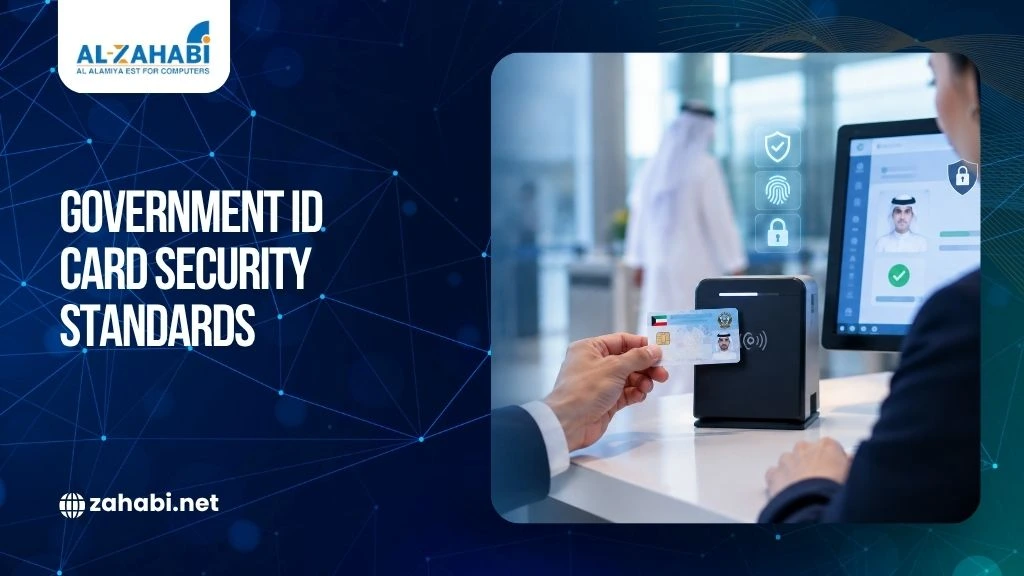
A government ID card is not just a printed piece of plastic. If the card is used to identify employees, control access to government facilities, or authenticate someone against a public-sector system, a weak issuance process can create a serious security gap.
That makes the choice of a government ID card printer in Kuwait only one part of a much larger decision. The card material, personalization process, identity verification, data protection, physical security features, and issuance controls all need to work together.
International government identity frameworks provide useful benchmarks for these requirements. For example, NIST’s FIPS 201 addresses identity proofing, registration, credential issuance, interoperability, and accreditation for U.S. federal PIV credentials, while ICAO Doc 9303 addresses secure design, manufacture, and issuance of machine-readable travel documents.
Key Takeaways:
- Government ID security starts with the issuance process, not just the printer.
- Secure cards should combine physical and digital protection measures.
- Identity proofing must happen before a credential is issued.
- Printers and card materials should support durability and tamper resistance.
- Kuwait public-sector projects should map international standards to their specific authority requirements.
What Secure Government ID Issuance Should Protect
When you evaluate a government ID card system, start with the risks rather than the hardware.
A secure system should help prevent someone from obtaining a credential under another person’s identity. It should also make unauthorized alteration, duplication, or misuse more difficult.
This means security needs to exist across the complete lifecycle:
Identity proofing → registration → personalization → issuance → authentication → replacement → revocation
NIST’s PIV requirements are a useful example of this lifecycle approach. They cover identity proofing and registration before issuance, biometric capture, credential personalization, verification of the intended recipient, and controls around the organizations and systems responsible for issuing credentials.
For public sector ID issuance in Kuwait, the same principle is important: don’t evaluate the printer separately from the processes and systems surrounding it.
Identity Proofing Before Card Personalization
A secure printer cannot compensate for a weak identity verification process.
Before a card is personalized, the issuing authority needs a reliable way to establish that the applicant is actually the person they claim to be.
A useful international benchmark comes from NIST FIPS 201. Its PIV issuance requirements include identity proofing, registration, biometric capture, and verification of the individual before the credential is released.
The practical lesson is straightforward: the person, identity record, and issued card must be connected through a controlled process.
For a government department, this could mean connecting the card issuance system to an approved identity database and requiring an authorized operator to verify the applicant before personalization.
This is especially important when issuing large numbers of employee, contractor, visitor, or facility-access cards.
Keep issuance access restricted
Not every employee should be able to create or modify government credentials.
Issuance software should use role-based access so that operators can perform only the tasks assigned to them.
For example, an operator may be allowed to print an approved credential but not change the identity information or authorize a new applicant.
That separation reduces the risk of an internal mistake or unauthorized credential creation.
Card Security Should Include More Than Printed Information
A photograph, name, department, and employee number are useful for visual identification. They are not enough by themselves to create a secure government credential.
A stronger card can combine visible security features with machine-readable or electronic credentials.
NIST’s PIV specification provides a useful example. It requires security features intended to resist counterfeiting and alteration and describes different inspection levels, including visible features, features requiring tools such as UV light or magnification, and forensic-level examination.
The exact features required for a Kuwait government credential should be defined by the relevant authority and procurement specification. However, the principle is broadly applicable: use multiple layers of verification rather than relying on one security feature.
Durable Card Materials and Secure Printing
Government credentials may remain in daily use for years. The card therefore needs to withstand normal handling, storage, and environmental exposure.
NIST’s PIV card requirements address durability and include testing considerations such as flexure, impact, abrasion, temperature and humidity exposure, and ultraviolet exposure.
This highlights an important procurement point. Before making a purchase, reviewing common ID card printer buying mistakes can help government procurement teams avoid selecting hardware that does not meet their security, durability, or operational requirements.
When choosing a government ID card printer in Kuwait, don’t ask only:
“How fast can it print?”
Also ask:
- What card materials does it support?
- Can the personalization process produce durable results?
- Can security elements be incorporated?
- Can cards be laminated or otherwise protected where required?
- Can the system maintain consistent print quality at the required volume?
A printer that produces attractive cards but cannot support the required security and durability specifications is not necessarily the right system for government issuance.
For the broader card hardware and consumables required for an issuance environment, the ID Cards & Accessories category can be considered as part of the procurement process.
Secure Personalization and Card Issuance
Personalization is the stage where approved identity data becomes a physical or electronic credential. Following a step-by-step ID card printing process can help issuance teams maintain consistency while ensuring that approved identity information is correctly transferred to each credential.
This stage needs particularly strong controls because unauthorized access to personalization equipment could potentially be used to create fraudulent credentials.
ICAO’s Doc 9303 provides an important international reference for secure document issuance. Its security specifications address the design, manufacture, personalization, issuance environment, personnel vetting, and protection of documents and components.
The broader lesson applies beyond travel documents.
Government ID production should control:
- Blank card inventory
- Personalization equipment
- Issuance credentials
- Operator access
- Card production records
- Rejected or damaged cards
- Replacement credentials
Track every issued credential
A secure system should make it possible to determine who authorized a card, when it was produced, and which identity record it belongs to.
ICAO’s document-security guidance also highlights measures such as physical security, audit trails, serial numbers, tracking of components, secure transport, and internal fraud protection.
That kind of traceability is particularly valuable when investigating a lost card, suspected counterfeit, or unauthorized issuance.
Add Authentication Beyond the Printed Card
For higher-security government applications, the card may need to do more than display information.
Smart-card credentials can store electronic identity information and support authentication mechanisms. Comparing PVC vs smart ID card options can help authorities determine whether a basic visual credential or a more advanced electronic card is appropriate for the intended use case.
NIST’s FIPS 201 framework, for example, defines government PIV credentials with cryptographic components and biometric data, while supporting interoperability between government identity systems.
This does not mean every government ID card in Kuwait needs the same PIV architecture.
Instead, it demonstrates why procurement teams should first define the required assurance level and authentication use cases before selecting card technology.
If the card only needs visual identification, a basic solution may be sufficient. If it controls access to sensitive facilities or systems, stronger electronic authentication may be appropriate.
Build Security Around the Issuance Environment
Security should extend beyond the card and printer.
The room where government credentials are produced can also require controls.
Consider restricting access to:
- Card printers
- Blank card storage
- Personalization workstations
- Card encoding equipment
- Issuance databases
- Rejected cards
- Printer ribbons and consumables
A simple operational example illustrates why this matters.
If a batch of unused cards is left in an unsecured office, an unauthorized person could potentially obtain them even though the printing system itself is protected.
Security therefore has to cover the complete production environment.
Use Audit Trails to Improve Accountability
Every sensitive action should ideally leave an appropriate record.
An audit trail can help answer questions such as:
- Who created the credential?
- Who approved it?
- When was it printed?
- Was it replaced?
- Why was the original cancelled?
- Which operator handled the issuance?
This becomes especially valuable when several employees operate the same issuance centre.
It also supports investigations when a credential is reported lost or suspected of being misused.
International identity standards consistently place emphasis on controlled issuance and accountable processes. FIPS 201, for example, requires agencies to use approved issuance processes and established reliable credential providers.
Connect Government ID Systems With Existing Technology
Government ID issuance rarely operates as an isolated activity.
Depending on the project, cards may interact with access control, attendance, visitor management, authentication systems, or other government applications.
This is where system integration becomes important.
A government department may issue a card centrally and then use it at multiple facilities. If each location maintains disconnected identity records, managing replacements and revoked credentials becomes more difficult.
The better approach is to define how the credential will interact with the wider identity infrastructure before selecting hardware.
For field teams or departments handling identity verification away from a central workstation, Mobile Computer solutions can also form part of the wider operational workflow. Zahabi’s current range includes enterprise mobile computers designed for retail, warehouse, and field-service environments, illustrating how mobile computing can support distributed workflows.
Self-Service and Controlled Government Kiosks
Not every identity-related interaction needs to happen at a staffed counter.
Depending on the government service and security requirements, Kiosk technology can support controlled self-service workflows such as document collection, check-in, information verification, or other approved interactions.
However, security should remain the priority.
A kiosk handling identity information should have appropriate user authentication, software controls, network security, privacy protections, and physical safeguards.
The presence of a kiosk should never mean that identity verification requirements are relaxed.
Zahabi’s existing kiosk content describes self-service kiosks as systems used for customer interaction, ordering, payment, and data collection, showing their broader role in automated workflows.
For government environments, the same technology should be adapted to the sensitivity of the service rather than treated as a simple retail kiosk.
Plan for Secure Card Replacement
A government ID system also needs to handle what happens after issuance.
Cards can be:
- Lost
- Stolen
- Damaged
- Expired
- Replaced after a role change
- Revoked after employment ends
A replacement process should not simply print another card using the same workflow without checking the status of the previous credential.
The old credential should be appropriately invalidated where the system supports electronic authentication or access control.
This is another reason lifecycle management should be included in the original procurement specification.
A printer alone cannot solve credential revocation or identity lifecycle problems.
Consider Barcode, QR, Smart Card, or Other Technologies Carefully
A government card may contain machine-readable information in addition to visible text.
The right technology depends on the use case. Understanding RFID vs barcode identification technologies can also help procurement teams distinguish between different machine-readable identification approaches before selecting the technology for a government credential.
A barcode or QR code may be suitable for certain identification or lookup workflows. A smart card or contactless credential may be more appropriate where stronger authentication is required.
The important point is not to add technology simply because it is available.
Define what the credential needs to accomplish first, then select the appropriate technology.
If barcode-based identification is part of the workflow, the Barcode Printing category can support related printing requirements. Zahabi currently offers desktop, industrial, and mobile barcode printing solutions, as well as labels and ribbons.
A Practical Procurement Checklist for Kuwait Government Projects
Before selecting a government ID card printer in Kuwait, procurement teams should evaluate the complete system against the project’s security requirements.
- Identity controls: Confirm that the system supports controlled identity proofing, registration, approval, and issuance.
- Card security: Define which visible, machine-readable, electronic, or tamper-resistant features are required.
- Printer capability: Check print quality, personalization capabilities, card compatibility, throughput, durability, and security options.
- Operator controls: Require appropriate authentication, permissions, and separation of responsibilities.
- Auditability: Make sure card issuance, replacement, cancellation, and other sensitive activities can be appropriately recorded.
- Physical security: Protect blank cards, printers, workstations, personalization equipment, and finished credentials.
- Lifecycle management: Define processes for expiration, replacement, revocation, and lost or stolen cards.
- Integration: Confirm compatibility with the identity database, access control systems, authentication infrastructure, and other applications that will use the credential.
These requirements should be mapped to the actual government authority’s procurement rules and security policies. International standards such as FIPS 201 and ICAO Doc 9303 can provide useful technical benchmarks, but they should not be presented as automatic legal requirements for Kuwait.
Why the Printer Is Only One Part of the Security Model
The biggest procurement mistake is treating the printer as the security system.
A secure government ID card printer in Kuwait is important, but it is only one component in a larger architecture.
The real security model combines trusted identity data, controlled issuance, secure personalization, durable cards, appropriate authentication technology, trained operators, physical controls, audit trails, and lifecycle management.
This is also why choosing hardware based purely on printing speed or purchase price can create problems later.
Before you request a quote, define the credential’s purpose, required security level, expected issuance volume, card technology, integration requirements, and lifecycle process.
Conclusion
Secure public sector ID issuance in Kuwait requires more than producing professional-looking cards. The system should protect the identity from enrollment through issuance, use, replacement, and revocation.
International frameworks such as NIST FIPS 201 and ICAO Doc 9303 show the importance of controlled issuance, identity verification, secure personalization, physical protection, and traceability.
If you are planning a government ID project, start with the security requirements and then select the printer, cards, software, and supporting hardware around them. Contact Zahabi to discuss the required ID card printing hardware and build a solution around your project’s issuance and security requirements. Zahabi lists ID card printing as part of its wider hardware and security solutions in Kuwait.
Frequently Asked Questions
1. What should I look for in a government ID card printer in Kuwait?
Look beyond print speed. Consider card durability, personalization capability, security-feature support, system integration, operator controls, and the expected volume of government credential issuance.
2. What are secure ID card standards?
Secure ID card standards are frameworks and technical requirements designed to strengthen identity proofing, credential issuance, authentication, physical card security, interoperability, and lifecycle management. NIST FIPS 201 is one international example for federal PIV credentials.
3. Is a photo ID enough for government security?
Not necessarily. A photo supports visual identification, but higher-security applications may require additional controls such as biometrics, smart-card credentials, cryptographic authentication, or other machine-readable technologies.
4. How can government agencies prevent unauthorized card issuance?
Use controlled identity proofing, role-based operator access, approval workflows, protected card stock, audit trails, and verification before releasing the credential. These controls help connect each issued card to an authorized identity and issuance event.