
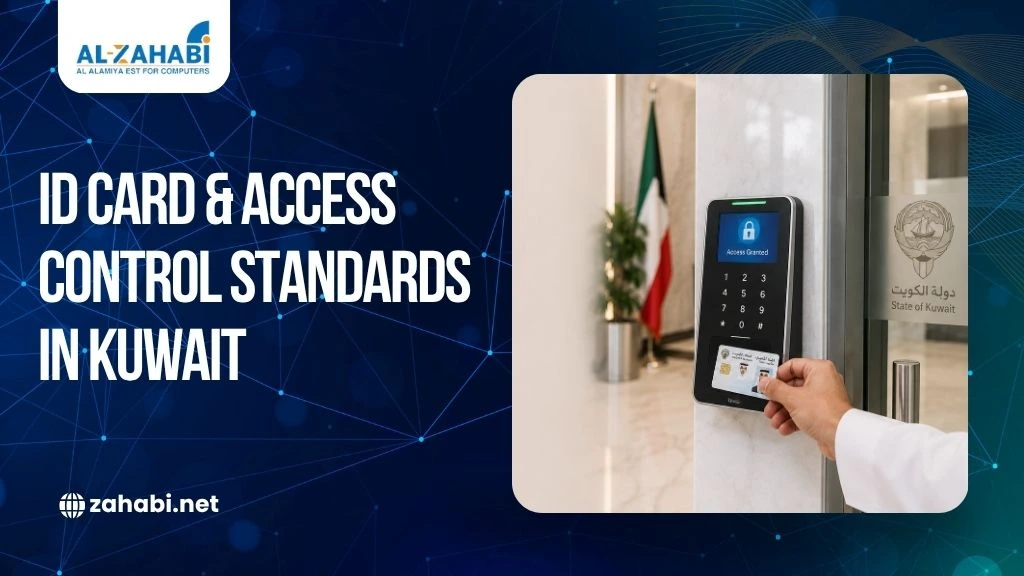
A government ID card does more than display an employee’s name and photograph. It can determine who enters a building, which areas they can access, and how security teams verify identity. For government institutions in Kuwait, getting this process wrong can create security gaps, administrative delays, and problems when employee information changes.
The ID card standards for government institutions in Kuwait should therefore be approached as a combination of official identity requirements and institution-specific access control procedures. Kuwait’s Public Authority for Civil Information (PACI) manages the Civil ID framework, while government institutions may use separate employee identification and building-access systems. PACI also provides Kuwait Mobile ID, which supports digital identity verification and authentication for government and private-sector services.
Understanding this distinction helps you build an ID system that is secure, practical, and easier to manage.
Key Takeaways:
- Civil ID requirements are governed through Kuwait’s official identity framework.
- Internal employee cards should be managed separately from Civil ID issuance.
- Access permissions should match each employee’s role and location.
- RFID cards can support controlled building and area access.
- Secure printing and controlled issuance help reduce identity risks.
Understanding ID Card Requirements in Kuwait
The first step is distinguishing between a government-issued Civil ID and an institution-issued employee or access card.
The Civil ID is part of Kuwait’s official civil information system and is administered by PACI. Its online services include card validity, renewal, card status, and other Civil ID-related services. Kuwait Government Online also provides an official service for checking smart card issuance requirements.
An employee ID card issued by a government institution serves a different purpose. It can identify the employee within the workplace and may be linked to building access, department permissions, attendance, or visitor management. Where attendance tracking is also required, biometric attendance systems can provide another method of verifying employee presence.
This means you should not treat an internal employee badge as a replacement for the official Civil ID. Instead, the two systems can work alongside each other.
For example, an employee may use their official Civil ID for government transactions while carrying an institution-issued badge to enter a restricted office building.
Official Identity and Internal Access Serve Different Purposes
PACI’s digital services show how identity verification is increasingly moving beyond the physical card. Kuwait Mobile ID provides a government-issued digital identity derived from the Civil ID and supports identity verification, authentication, digital signatures, and a government credentials wallet.
An internal access badge has a narrower operational role. It tells your security system who the cardholder is and what access rights have been assigned to that person.
This distinction is important when planning secure ID card issuance in Kuwait. Your institution should define which information belongs on the physical employee card and which information should remain within the access control system.
Core Elements of a Secure Government Employee ID
A government employee card should provide enough information for practical identification without unnecessarily exposing sensitive data.
A typical institutional card may include the employee’s photograph, name, employee or staff number, department, job title, and institution branding. The exact information should follow the institution’s approved security and identification policy.
The card can also contain a machine-readable element where required. A complete office ID badge system can bring employee cards and supporting identification components together into a more organised setup. Depending on the access system, this may be an RFID credential, barcode, QR code, or another supported technology.
The important point is to separate visible identification from electronic credentials. A card may look simple while containing an electronic credential that the access system uses to verify the cardholder.
Secure Issuance Starts Before Printing
A secure ID programme should control the entire issuance process, not just the printing stage.
The institution should establish who can request a card, who approves it, who can print it, who activates the credential, and who can deactivate it.
Following an ID card printing guide can help operators understand the key stages involved in producing and issuing employee badges.
This becomes especially important when employees transfer departments, leave employment, or require temporary access.
For example, if an employee moves from a public-facing department to a restricted records area, their physical card may remain visually similar while their access permissions are changed in the access control system.
This approach reduces unnecessary card replacements while keeping permissions aligned with job responsibilities.
ID Card Printing in Kuwait for Government Institutions
Professional ID card printing in Kuwait requires more than producing a clear photograph and employee name.
The printing process should be consistent and controlled. Cards should be produced using approved designs, compatible card materials, and equipment capable of maintaining reliable print quality.
A professional ID card printer can support the production of employee badges at the institution rather than relying on informal or uncontrolled printing methods.
The workflow can include employee data verification, photograph approval, card design, printing, credential encoding, quality inspection, and issuance.
This creates a traceable process.
Choosing the Right Card Material
PVC cards are commonly used for employee identification because they are practical for everyday handling. However, the right card material depends on the required durability, printer compatibility, and card technology.
A proximity blank PVC ID card can be appropriate when the access control system uses proximity credentials and the card is compatible with the selected printer and encoding technology.
The key is to verify compatibility before purchasing cards in bulk.
When selecting printing equipment, comparing single vs dual-sided printers can help determine which option suits the institution’s card design requirements.
A card that looks correct physically may still be unsuitable for a particular printer, RFID technology, or access control platform.
Access Control Systems for Government Offices
An access control system for government offices should do more than unlock doors.
It should help the institution control who can enter specific locations and maintain appropriate access permissions.
A basic setup may include:
- Employee credentials
- Card readers
- Door controllers
- Access control software
- Management database
- Security monitoring
The system can assign different permissions according to role, department, building, or working schedule.
For example, an employee working in a general administrative office may have access to the main entrance and their department. A technical employee may require additional access to equipment rooms, while visitors may receive temporary credentials with limited permissions.
This role-based approach is more practical than giving every cardholder the same access.
Access Permissions Should Follow the Employee’s Role
The card itself does not need to display every permission assigned to an employee.
Instead, the access control platform can store those permissions electronically.
This provides flexibility when responsibilities change.
If an employee moves to another department, the administrator can update the access profile without necessarily printing a new card.
When an employee leaves, the credential can be deactivated promptly.
That makes access management an ongoing process rather than a one-time card issuance task.
Before deployment, define access zones and approval responsibilities so your security team knows exactly who can authorise, modify, and revoke permissions.
RFID Access Control Cards in Government Facilities
RFID access control cards are widely used for contactless identification. The card communicates with a compatible reader, allowing the system to recognise the credential without requiring physical insertion.
This can be useful in government facilities where employees move through controlled entrances throughout the day.
However, RFID is not one universal technology. Different systems can use different frequencies, credential technologies, security features, and encoding methods.
You should therefore select the card based on the existing access control infrastructure rather than purchasing a generic RFID card first.
For example, replacing an existing access system may require cards that are compatible with the installed readers and controllers. A visually identical card may not work if its underlying technology is different.
RFID Does Not Replace Access Management
An RFID blank pvc id card is only one part of the security system.
The reader, controller, software, credential database, and administrative policies all contribute to access security.
If a card is lost, the institution should be able to identify the credential and deactivate it quickly.
Similarly, access logs should be managed according to the institution’s security and data-handling policies.
This is why buying cards without reviewing the complete system can create compatibility and security problems.
ID Card Compliance Requirements and Data Handling
There is an important distinction between official Civil ID compliance and internal institutional card policies.
PACI publishes requirements and services for Civil ID issuance, renewal, validity, status, and related processes. For example, PACI’s terms state that photographs submitted for certain Civil ID transactions must meet specified standards.
Internal employee badges are governed by the institution’s own approved policies and the requirements applicable to its access control environment.
Therefore, do not assume that an internal employee badge must reproduce every field or specification found on the Civil ID.
Instead, establish a documented internal standard covering:
- Approved card design
- Required employee information
- Photograph requirements
- Card numbering
- Credential technology
- Access approval
- Replacement procedures
- Lost-card handling
- Card deactivation
- Printing and issuance responsibilities
This gives your institution a consistent framework for ID card compliance requirements.
Managing Lost, Stolen, and Expired Cards
Card lifecycle management is one of the most important parts of a secure ID system.
A lost card should not remain active simply because the employee has reported it missing. The corresponding credential should be identified and deactivated according to the institution’s procedure.
Replacement should also follow a controlled process.
The same principle applies when an employee leaves the institution. Their physical card should be collected where applicable, and the associated access credential should be disabled.
PACI separately provides official Civil ID services for card status, renewal, and related transactions, so internal badge procedures should not be confused with Civil ID processes.
Digital Identity and the Future of Government Identification
Physical employee cards remain useful for building access, but government identity is becoming increasingly digital.
Kuwait Mobile ID provides a digital Civil ID and supports identity verification, authentication, digital signatures, and credential verification through QR codes. PACI states that the service is available for government and private-sector digital services.
This does not automatically mean physical access badges will disappear.
Building access has different operational requirements from online identity verification. A government institution may continue using physical RFID credentials for doors while employees use Kuwait Mobile ID for supported digital services.
The practical approach is to treat physical and digital identity as complementary systems where appropriate.
If you are modernising an existing identification system, review physical badges, access credentials, and digital identity workflows together instead of upgrading only one part of the process.
Building a Practical Government ID Card Standard
A useful internal standard should be specific enough for administrators, security teams, and ID card operators to follow consistently.
Start with the purpose of the card. Is it primarily for visual identification, access control, attendance, visitor management, or several functions together?
Next, define the technology. If RFID is required, identify the exact credential technology and confirm compatibility with the installed readers.
Then establish the issuance workflow. The institution should know who verifies employee information, who approves cards, who prints them, who activates credentials, and who handles replacements.
Finally, document the lifecycle. A card should have a clear process for issuance, renewal, replacement, suspension, and deactivation.
This framework makes ID card standards for government institutions in Kuwait easier to apply consistently across departments and locations.
Conclusion
Effective government ID management in Kuwait requires a clear separation between official Civil ID requirements and institution-specific employee access credentials. PACI manages the official Civil ID framework and related digital identity services, while government institutions can establish controlled internal processes for employee identification and building access. By combining secure issuance, compatible card technology, role-based access, controlled printing, and proper credential lifecycle management, you can build an ID system that supports both security and everyday operations.
Frequently Asked Questions
1. What are the ID card standards for government institutions in Kuwait?
There is not one publicly identified universal standard covering every internal government employee badge. Civil ID requirements are handled through PACI, while institutions may establish internal identification and access procedures.
2. Can RFID cards be used for government office access?
Yes, RFID credentials can be used where the installed access control system supports the relevant RFID technology. Card and reader compatibility should be verified before deployment.
3. Is an employee ID card the same as a Kuwait Civil ID?
No. The Civil ID is an official identity document administered through PACI. An employee ID card is generally an institution-issued credential used for workplace identification or access.
4. What should happen when a government employee loses an access card?
The associated access credential should be reported and deactivated according to the institution’s security procedure. A replacement should then be issued through the approved process.
5. Does Kuwait Mobile ID replace physical government employee badges?
Not necessarily. Kuwait Mobile ID provides digital identity and authentication capabilities, while physical employee badges can continue to serve workplace identification and building-access functions.