
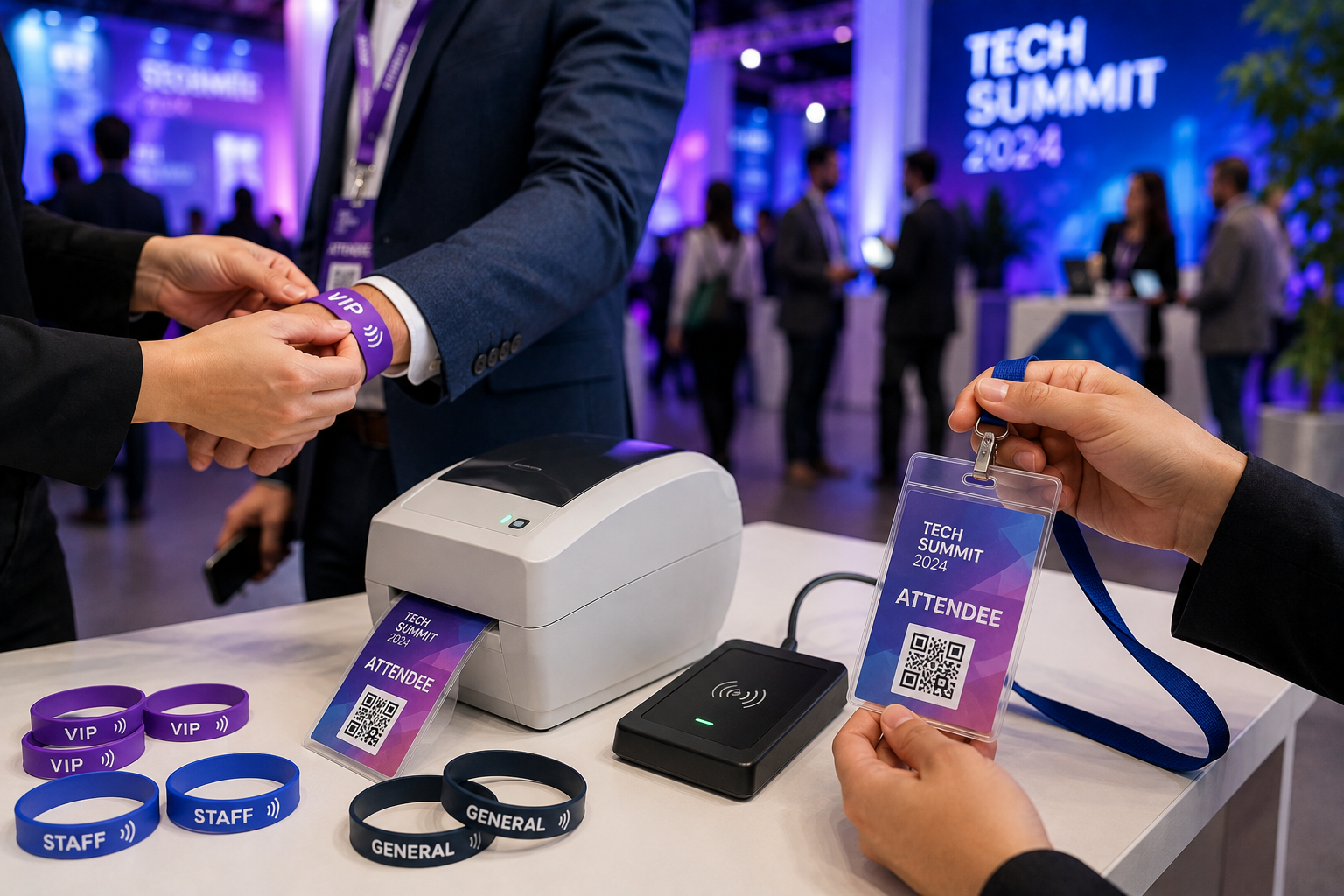
Long queues at registration, misplaced badges, and unauthorised access can quickly turn a well-planned event into a difficult experience. If you are organising a conference, exhibition, festival, corporate event, or private gathering in Kuwait, your attendee credentials need to do more than display a name.
RFID wristbands for events in Kuwait can help you connect attendee identification with access control and event operations. Instead of relying only on printed tickets or manually checked badges, RFID credentials can be read electronically at designated points. Depending on the system, the same credential can support entry, restricted-area access, attendance tracking, or other event functions.
But RFID is only one part of the setup. You also need the right wristbands, badge stock, printers, readers, software, and consumables. This guide explains how these pieces fit together so you can plan your event credentialing system with fewer surprises.
Key Takeaways:
- RFID wristbands can combine identification with event access control.
- Badge printing requirements depend on attendee type and event size.
- Preprinted and on-demand badges suit different registration workflows.
- RFID hardware must match your access-control and software setup.
- Planning supplies early helps avoid event-day printing and credential issues.
RFID Credentials and Their Role in Event Management
An event credential identifies who a person is and what access they should have. Traditionally, this could mean a printed badge, paper ticket, or wristband checked manually at an entrance.
RFID adds an electronic identifier to that credential. A compatible reader can then recognise the credential and communicate the relevant information to the event system.
This makes RFID useful when your event has multiple entry points or different access levels. For example, a conference may give general attendees access to exhibition areas while speakers and organisers receive additional permissions.
The important point is that RFID does not automatically solve every event-management problem. Your wristband or badge, reader, software, and access rules must work together.
That is why you should plan the complete credentialing workflow before ordering individual components.
Choosing Between RFID Wristbands and Printed Badges
The right credential depends on how people will move through your event.
RFID wristbands are particularly useful for festivals, outdoor events, multi-day gatherings, and environments where attendees need a credential that stays with them throughout the event.
A wristband can be issued once and used at designated RFID access points. This avoids asking attendees to repeatedly present a paper ticket or search through a bag for a badge.
Printed badges are often more suitable for conferences, exhibitions, trade shows, and corporate events. They provide visible information such as the attendee’s name, company, job title, or access category.
For a business conference, for example, a printed badge can make networking easier because other attendees can identify the person without using a reader.
You can also combine both approaches. When printed credentials are required, comparing PVC vs smart ID card options can help planners choose suitable card materials and technologies for their event. An event may use a printed badge for visible identification while using an RFID-enabled credential for restricted access.
Planning RFID Wristbands for Events in Kuwait
When selecting RFID wristbands for events in Kuwait, start with the event environment rather than the wristband design.
A one-day outdoor festival has different requirements from a three-day business conference. You need to consider how long the credential will be worn, whether attendees need to remove it, and whether it will be used at multiple access points.
Material also matters.
Disposable wristbands can suit short-duration events, while more durable options may be appropriate for multi-day programmes. The wristband should remain comfortable while also being difficult to transfer between attendees if access control is important.
You should also confirm which RFID technology is supported by your readers and event-management platform before placing a bulk order. Understanding the RFID inventory system cost can also help event planners estimate the budget required for RFID hardware, credentials, and supporting equipment.
A wristband that looks suitable but is incompatible with your system can create unnecessary replacement costs.
Building an RFID Event Access Control Setup
RFID event access control works by connecting credentials to authorised permissions.
The basic workflow is straightforward. An attendee receives a wristband or badge containing an RFID identifier. At an access point, a compatible reader detects the credential and checks the associated permission.
For example, you might configure access so that:
- General attendees enter the main exhibition area.
- VIP attendees enter a designated lounge.
- Speakers access speaker rooms.
- Staff access operational areas.
This approach gives you more control than relying only on visual badge colours.
It can also reduce the need for staff to manually verify every credential at every restricted entrance.
However, access rules need to be configured and tested before the event. Avoiding common RFID implementation mistakes can help event organisers prevent compatibility and access-control issues before the event begins. Your team should know what happens when an invalid, duplicate, lost, or unauthorised credential is presented.
Planning Access Zones
Create an access map before ordering your hardware.
Mark the main entrance, VIP areas, speaker rooms, backstage zones, workshops, and other restricted spaces. Then decide which credential types should be permitted at each location.
This helps determine how many readers you need and where they should be positioned.
It also prevents a common planning problem: purchasing equipment first and trying to design the access workflow around it later.
Event Badge Printing in Kuwait
For conferences and exhibitions, event badge printing in Kuwait requires careful planning because registration data can change until the event begins.
Attendees may register late, change companies, request corrections, or arrive without completing their registration.
This is where on-demand printing can be useful.
Instead of producing every badge weeks before the event, you can print attendee information as people check in. A suitable badge printer can produce the required name and registration details while the registration system supplies the attendee data. A step-by-step ID card printing guide can also help event teams understand the basic stages involved in producing badges efficiently.
For example, if a delegate changes their company name shortly before arrival, an on-demand workflow allows the registration team to issue a corrected badge rather than manually modifying a preprinted credential.
Preprinted Event Badges vs On-Demand Printing
Both approaches have a place in event planning.
Preprinted event badges are useful when attendee information is confirmed well in advance. You can print event branding, sponsor information, graphics, and other fixed elements before the registration period.
On-demand printing is more flexible when attendee information changes frequently.
A hybrid approach can also work well. You can preprint the event design and branding while leaving the attendee-specific information for the printer to add during check-in.
This can reduce the amount of personalised printing required on-site while retaining flexibility.
The right option depends on your registration process, attendee volume, and how often registration information changes.
Selecting a Badge Printer for Conferences
A badge printer for conferences should match your registration workflow rather than simply your expected attendee count.
Start by considering how many badges need to be printed during the busiest registration period. Average daily attendance is less useful than peak check-in demand.
If 500 attendees are expected, but most arrive within a two-hour window, your printing setup needs to handle that concentrated demand.
Also consider the badge material, print size, colour requirements, connectivity, and compatibility with your registration software.
Before the event, run complete test prints using the same badge stock you plan to use on-site. Avoiding common ID card printer buying mistakes can help organisers reduce printing problems during peak registration periods. This helps identify alignment, formatting, connectivity, and readability issues before attendees arrive.
Creating a Practical Printing Station
Your printing station should have more than a printer.
Plan space for the registration computer, badge stock, ribbons, or other required consumables, spare credentials, and finished badges.
Keep replacement supplies close enough for staff to access quickly without leaving the registration desk.
If several registration counters are operating simultaneously, standardise the setup across stations. This makes troubleshooting easier and keeps the attendee experience consistent.
Understanding RFID Hardware Solutions
Your event may require several types of RFID hardware solutions, depending on the access workflow.
Common components can include RFID readers, antennas, encoded wristbands or badges, networking equipment, and compatible software.
Depending on the credential format, RFID printers for accurate tag printing can also support the encoding and printing requirements of an event access system.
A simple event with one controlled entrance may need much less equipment than a large venue with multiple gates and restricted zones.
Reader placement is particularly important. Physical surroundings, crowd movement, and the credential type can influence how effectively the system reads credentials.
Do not treat hardware selection as an isolated purchase. Confirm compatibility between the RFID credential, reader, software, and access-control platform before deployment.
Managing RFID and Label Printing Supplies
Event planners sometimes focus heavily on hardware and overlook consumables.
However, RFID and label printing supplies should be included in the event checklist from the beginning.
Depending on your setup, you may need RFID wristbands, RFID-enabled badge stock, standard badge stock, ribbons, labels, cleaning supplies, and spare credentials.
Your quantities should account for more than the confirmed attendee list.
Late registrations, damaged credentials, printing mistakes, and replacements can increase actual consumption.
For example, if 1,000 attendees are confirmed, ordering exactly 1,000 credentials leaves no room for replacements. A planned contingency quantity provides more flexibility during registration.
Other Credential Formats for Events
RFID wristbands and badges are not the only options available.
Some events use preprinted ID cards for staff, exhibitors, contractors, or long-term credentials. These can be useful when the same people need visible identification throughout the event.
Hang tags can be used for equipment, vehicles, access-controlled items, or other event assets where a wearable credential is not appropriate.
Key fobs can also support access applications where a compact credential is preferable to a badge or wristband.
The credential should always match the job it needs to perform. An attendee at a multi-day festival may benefit from a wristband, while a contractor responsible for event equipment may be better identified using another credential format.
Preparing for Event-Day Credential Problems
Even a well-designed RFID setup needs a contingency plan.
Prepare for lost wristbands, damaged badges, incorrect attendee information, printer issues, network interruptions, and unexpected registrations.
Your registration team should know how to deactivate a lost credential and issue a replacement when the system supports this function.
Keep spare credentials available at the registration area. Test backup procedures before the event rather than discovering problems when the first attendee reaches the entrance.
You should also maintain a clear escalation process. Staff at the gate should know when to resolve an issue themselves and when to send an attendee back to registration.
Conclusion
Planning RFID wristbands for events in Kuwait involves more than selecting a wristband or badge. You need to consider access permissions, RFID hardware, printing requirements, consumables, registration workflows, and contingency planning together. When these elements are tested as one system before event day, you can reduce registration friction and give your team greater control over attendee access.
If you are planning an upcoming conference, exhibition, festival, or corporate event, start by mapping your attendee categories and access zones. From there, you can select the appropriate RFID credentials, printing equipment, and supporting hardware for the event.
1. Are RFID wristbands suitable for conferences?
Lorem i.psum dolor sit amet, consectetur adipiscing elit. Ut elit tellus, luctus nec ullamcorper mattis, pulvinar dapibus leo
2. Can RFID badges and wristbands be used together?
Lorem i.psum dolor sit amet, consectetur adipiscing elit. Ut elit tellus, luctus nec ullamcorper mattis, pulvinar dapibus leo
3. What should an event badge printer support?
Check print speed, badge size, colour requirements, media compatibility, connectivity, and integration with your registration software.
4. How many spare RFID wristbands should an event planner keep?
Keep a contingency quantity based on expected registrations and replacement needs rather than ordering only the exact confirmed attendee count.
5. Can RFID credentials be replaced if an attendee loses one?
In systems that support credential management, a lost credential can generally be deactivated and a replacement issued. Your event team should test this process before the event.