
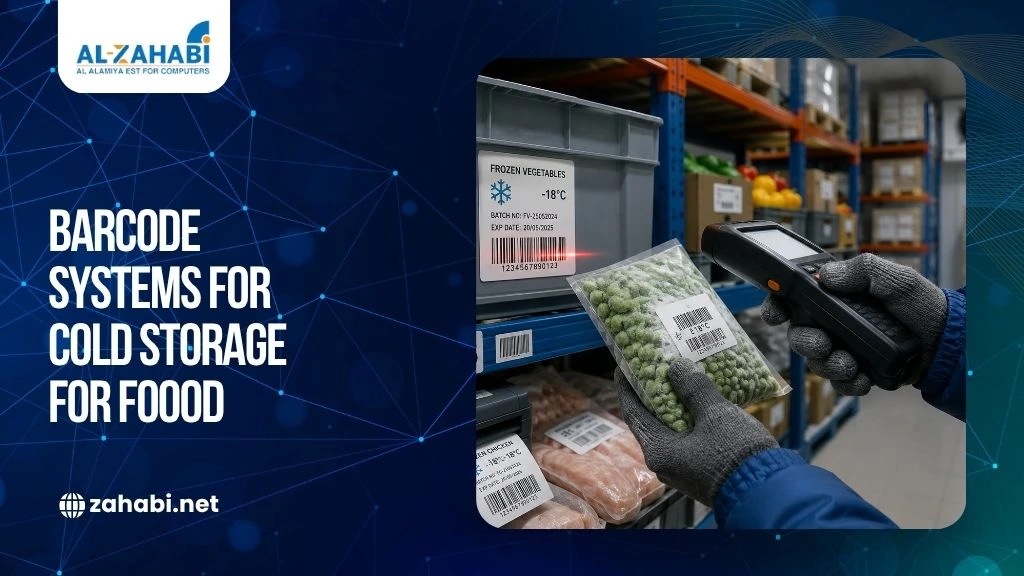
Managing food inventory in cold storage is more challenging than managing products in a standard warehouse. Temperature-controlled environments, strict expiry dates, batch tracking, and regulatory requirements leave little room for error. A single misplaced pallet or incorrect inventory record can lead to product spoilage, costly recalls, or delays in fulfilling customer orders.
A cold storage barcode system helps solve these challenges by providing accurate product identification and real-time inventory tracking throughout the supply chain. From receiving frozen goods to dispatching orders, barcode technology improves visibility, reduces manual errors, and supports food safety compliance.
Whether you operate a frozen food warehouse, dairy distribution centre, seafood processing facility, or temperature-controlled logistics business, implementing the right barcode system can make warehouse operations faster, more accurate, and easier to manage.
Key Takeaways:
- Barcode systems improve inventory accuracy in cold storage facilities.
- Real-time tracking supports better food traceability and compliance.
- Durable barcode labels withstand moisture and freezing temperatures.
- Mobile barcode technology speeds up warehouse operations.
- The right hardware reduces errors and improves cold chain efficiency.
Why Cold Storage Warehouses Need Barcode Systems
Unlike ordinary warehouses, cold storage facilities deal with products that have limited shelf lives and strict temperature requirements. Every movement—from receiving and storage to picking and shipping—must be recorded accurately to maintain product quality and traceability.
Manual inventory tracking often becomes difficult in these environments. Employees may need to work in low temperatures while handling large quantities of products, making paper-based records or manual data entry slow and prone to errors.
A cold storage barcode system replaces manual processes with fast and reliable barcode scanning. Every carton, pallet, or product can be identified instantly, helping warehouse teams maintain accurate inventory records without unnecessary paperwork.
For example, a frozen seafood distributor receiving multiple shipments daily can scan incoming products, assign storage locations, and update inventory within seconds instead of manually recording stock information.
Common Challenges in Cold Storage Inventory Management
Cold storage operations face unique challenges that traditional warehouses rarely encounter.
These include:
- Frequent stock rotation
- Temperature-sensitive products
- Expiry date management
- Batch and lot tracking
- High inventory turnover
- Regulatory compliance
Without proper inventory visibility, businesses risk shipping expired products, storing items incorrectly, or losing valuable stock.
Barcode technology helps minimise these risks by keeping inventory records updated throughout the warehouse.
How a Cold Storage Barcode System Works
A barcode system connects products, warehouse staff, inventory software, and scanning devices into one integrated workflow.
Every product receives a barcode containing important information such as:
- Product identification
- Batch number
- Lot number
- Production date
- Expiry date
- Storage location
Warehouse employees scan these barcodes whenever products move through the facility.
Following GS1 barcode standards helps businesses maintain consistent product identification and improve traceability across the food supply chain.
Instead of relying on memory or handwritten notes, inventory updates occur automatically within the warehouse management system.
For example, when frozen chicken products arrive at a distribution centre, warehouse staff scan each pallet before assigning it to a designated freezer location. The inventory database updates immediately, making the products visible for future order picking.
This real-time visibility reduces inventory discrepancies and improves operational efficiency.
Improving Food Warehouse Operations with Barcode Technology
A food warehouse barcode system supports nearly every warehouse process.
1. Receiving Products Faster
Receiving goods becomes significantly quicker because employees only need to scan product barcodes rather than entering information manually.
Incoming shipments can be verified against purchase orders immediately, reducing receiving errors.
For example, if a dairy supplier delivers fewer cartons than expected, barcode scanning highlights the discrepancy before inventory is accepted.
2. Accurate Storage Location Tracking
Large cold storage facilities often contain multiple freezer zones.
Without accurate location tracking, employees may spend valuable time searching for products.
Barcode systems assign each storage rack, shelf, or pallet position a unique barcode.
Employees simply scan both the product and storage location, ensuring inventory remains correctly organised.
This improves warehouse efficiency while reducing misplaced inventory.
3. Faster Order Picking
Picking errors are expensive in food distribution.
Incorrect shipments may result in customer complaints, product returns, or wasted inventory.
Barcode-guided picking verifies each product before it leaves storage.
If the wrong item is scanned, the warehouse management system immediately alerts the operator.
This extra verification step improves order accuracy while reducing costly mistakes.
Food Traceability Starts with Accurate Identification
Food safety regulations increasingly require businesses to trace products throughout the supply chain.
A modern food traceability system begins with accurate barcode identification.
Each scan creates a digital record showing where products have been stored, moved, or shipped.
This information becomes invaluable during quality investigations or product recalls.
Imagine a packaged meat manufacturer discovering a quality issue affecting one production batch.
Instead of recalling every product, barcode records allow the company to identify exactly which batch numbers were distributed, where they were shipped, and which customers received them.
This targeted approach saves both time and money while protecting consumer safety.
Supporting Frozen Food Inventory Management
Managing frozen inventory requires more than simply counting products.
Warehouse teams must monitor:
- Expiry dates
- First Expired, First Out (FEFO) rotation
- Batch movement
- Product availability
- Storage conditions
A barcode-based frozen food inventory management system simplifies these processes by providing accurate inventory visibility.
For example, warehouse software can identify products approaching their expiry dates, allowing staff to dispatch older inventory first.
This reduces waste while improving stock rotation.
For businesses handling thousands of frozen products, barcode automation becomes an essential part of maintaining inventory accuracy.
Cold Chain Tracking Throughout the Supply Chain
Food products often move through multiple locations before reaching customers.
A typical journey may include:
- Manufacturing plant
- Cold storage warehouse
- Distribution centre
- Transport vehicle
- Retail store
Every movement increases the importance of maintaining product visibility.
Cold chain tracking supported by barcode scanning ensures products remain identifiable throughout transportation and storage.
If delays occur during delivery, businesses can quickly identify affected shipments and take corrective action.
For example, a frozen dessert manufacturer distributing products across Kuwait can monitor inventory from production through warehouse storage and final retail delivery using barcode scanning at each stage.
Warehouse Barcode Labels Must Withstand Harsh Conditions
Barcode quality is especially important in refrigerated and frozen environments.
Standard paper labels may deteriorate when exposed to:
- Moisture
- Condensation
- Low temperatures
- Ice formation
- Frequent handling
High-quality warehouse barcode labels are specifically designed for cold storage applications.
Synthetic materials combined with strong adhesives remain attached even under freezing conditions.
This ensures products remain scannable throughout storage, transportation, and distribution.
Choosing the correct label material is just as important as selecting the barcode printer itself.
The Role of Industrial Printers in Cold Storage
Cold storage facilities often print thousands of labels every week.
Standard office printers cannot provide the durability or print quality required for warehouse environments.
Industrial Printers are built for continuous operation and high-volume label production.
They offer:
- Faster print speeds
- High-resolution barcode printing
- Durable construction
- Support for specialised label materials
- Consistent print quality
For example, a frozen food processing facility printing pallet labels throughout multiple production shifts benefits from industrial printers capable of operating reliably without frequent maintenance.
You can also learn how to reduce printing costs without compromising barcode quality or durability.
Barcode Scanners Keep Warehouse Operations Moving
A barcode system is only as effective as the devices used to capture data. In busy cold storage facilities, employees need scanners that can read barcodes quickly, even in low-light conditions or when labels are covered with condensation.
Modern Barcode Scanners are designed to handle demanding warehouse environments. Understanding different barcode scanner types can help businesses select the right device for cold storage applications. They can scan damaged or partially obscured barcodes, reducing delays during receiving, picking, and dispatch.
For example, a worker loading frozen food pallets onto delivery trucks can verify each pallet with a quick scan instead of manually checking product codes. This speeds up loading while reducing shipping errors.
When selecting scanners, businesses should consider scanning range, durability, battery life, and compatibility with their warehouse management system.
Mobile Computers Enable Real-Time Inventory Updates
Traditional barcode scanners capture data, but mobile computers take warehouse productivity a step further. These handheld devices combine barcode scanning with wireless connectivity, allowing employees to access inventory information instantly.
Instead of scanning products and updating records later, warehouse staff can:
- Confirm stock availability
- Verify storage locations
- Check expiry dates
- Receive picking instructions
- Update inventory in real time
For instance, if a picker is preparing an order for frozen vegetables, a mobile computer can display the correct storage location, confirm the right batch, and automatically update inventory once the products are scanned.
This eliminates duplicate data entry and gives managers real-time visibility across the warehouse.
Choosing Barcode Labels for Cold Storage
Barcode labels used in cold storage must remain readable despite freezing temperatures, moisture, and regular handling.
When selecting barcode labels, businesses should consider:
- Temperature resistance
- Adhesive performance
- Surface compatibility
- Print durability
- Expected product lifespan
For example, labels applied to frozen meat cartons require stronger adhesives than labels used on dry packaged goods. Similarly, products stored for several months need labels that resist fading and abrasion.
Choosing the wrong label material may lead to peeling, smudging, or scanning failures, creating unnecessary operational delays.
If you’re evaluating label options, it’s also worth exploring a label type to understand which materials suit different warehouse conditions.
Building an Efficient Cold Storage Workflow
A successful barcode system supports every stage of warehouse operations, not just inventory counting.
A typical workflow includes:
- Product Receiving: Incoming products are scanned immediately upon arrival. The warehouse management system verifies quantities, records batch numbers, and assigns storage locations.
- Put-Away: Employees scan both the product and the storage location before placing inventory into freezers or chilled storage. This creates an accurate location record for future retrieval.
- Inventory Management: Regular stock checks become faster because warehouse staff scan products instead of counting manually. Inventory discrepancies are identified immediately, helping maintain accurate stock levels.
- Order Picking: When customer orders are received, the system guides employees to the correct storage locations. Barcode verification ensures the right products are picked, reducing fulfilment errors.
- Shipping: Before dispatch, products are scanned one final time to confirm that the shipment matches the customer’s order. This extra validation step helps prevent costly returns and customer complaints.
Common Mistakes to Avoid When Implementing a Barcode System
Introducing barcode technology can transform warehouse operations, but poor implementation often limits its benefits.
Some common mistakes include:
- Choosing labels that cannot withstand cold environments
- Printing barcodes with insufficient resolution
- Skipping employee training
- Failing to standardise barcode placement
- Not integrating barcode devices with warehouse software
For example, if barcodes are placed inconsistently across different cartons, employees may spend extra time searching for labels during scanning. Standardising label placement improves speed and reduces handling time.
Planning the implementation carefully helps businesses avoid these operational issues.
How Barcode Systems Improve Food Safety Compliance
Food businesses must demonstrate that products can be traced throughout the supply chain. Barcode technology simplifies compliance by creating a digital history of every inventory movement.
Barcode records help businesses:
- Track production batches
- Monitor expiry dates
- Identify affected products during recalls
- Verify shipment history
- Maintain accurate inventory records
Imagine a dairy producer identifying a quality issue affecting one day’s production. With a barcode-based traceability system, the company can quickly locate the affected batch instead of recalling every product in circulation.
This targeted approach reduces waste, limits financial losses, and helps protect consumer confidence.
Measuring the Return on Investment
Many businesses initially view barcode technology as an equipment expense. In reality, it is an operational investment that delivers measurable long-term benefits. Calculating automation ROI helps businesses understand the long-term value of investing in barcode technology.
A well-designed cold storage barcode system can help reduce:
- Manual data entry
- Inventory inaccuracies
- Picking mistakes
- Product waste
- Time spent locating stock
It can also improve:
- Warehouse productivity
- Inventory visibility
- Customer order accuracy
- Regulatory compliance
- Decision-making through real-time data
For growing food distributors, these operational improvements often outweigh the initial investment in barcode hardware and software.
Scaling Your Barcode System as Your Business Grows
One advantage of barcode technology is its scalability. Businesses can begin with a simple setup and expand as operations become more complex.
For example, a small frozen food distributor may start with barcode labels, handheld scanners, and a desktop printer. As order volumes increase, the business can introduce industrial printers, mobile computers, automated warehouse software, and even RFID technology for pallet-level tracking.
Planning for future growth helps avoid costly system replacements later.
If you’re considering long-term warehouse automation, comparing RFID vs Barcode which is better technology can help determine which solution best suits your operational needs.
Choosing the Right Hardware for Long-Term Performance
Reliable hardware is essential for maintaining barcode accuracy in demanding warehouse environments.
When evaluating equipment, look for solutions that offer:
- Durable construction for cold environments
- High-quality barcode printing
- Fast and accurate scanning
- Easy integration with warehouse management software
- Scalable performance as your business grows
It’s also important to minimise equipment downtime. Unexpected printer failures can delay receiving, shipping, and production schedules. Reducing printer downtime helps keep receiving, labelling, and shipping operations running without costly interruptions.
Ready to Improve Your Cold Storage Operations?
Whether you’re managing a frozen food warehouse, dairy distribution centre, or temperature-controlled logistics facility, the right barcode solution can make daily operations more accurate and efficient. From durable barcode labels to industrial printers, scanners, and mobile computers, investing in reliable technology today helps build a more resilient supply chain tomorrow.
Conclusion
A cold storage barcode system is more than a tool for printing and scanning labels—it is the foundation of accurate inventory management, food traceability, and efficient cold chain operations. By combining durable barcode labels, industrial printers, barcode scanners, and mobile computers, food businesses can reduce manual errors, improve compliance, and maintain product visibility from receiving to delivery. As customer expectations and food safety requirements continue to evolve, implementing a reliable barcode system positions your business for long-term operational success.
1. What is a cold storage barcode system?
A cold storage barcode system uses barcode labels, scanners, printers, and inventory software to track products accurately in refrigerated and frozen warehouse environments.
2. How do barcode systems improve food traceability?
Every barcode scan records product movement, batch information, and storage history. This creates a digital trail that supports faster recalls, better inventory control, and regulatory compliance.
3. Which barcode labels are best for frozen warehouses?
Synthetic barcode labels with freezer-grade adhesives are generally the best choice because they resist moisture, condensation, and low temperatures while remaining easy to scan
4. Why are mobile computers useful in food warehouses?
Mobile computers allow warehouse staff to scan products, verify stock levels, update inventory, and complete picking tasks in real time without returning to a workstation.
5. Can a barcode system grow with my business?
Yes. Most barcode systems are highly scalable. Businesses can start with basic barcode printing and scanning, then expand to advanced warehouse management, mobile computing, and RFID solutions as operations grow.s


Add comment