
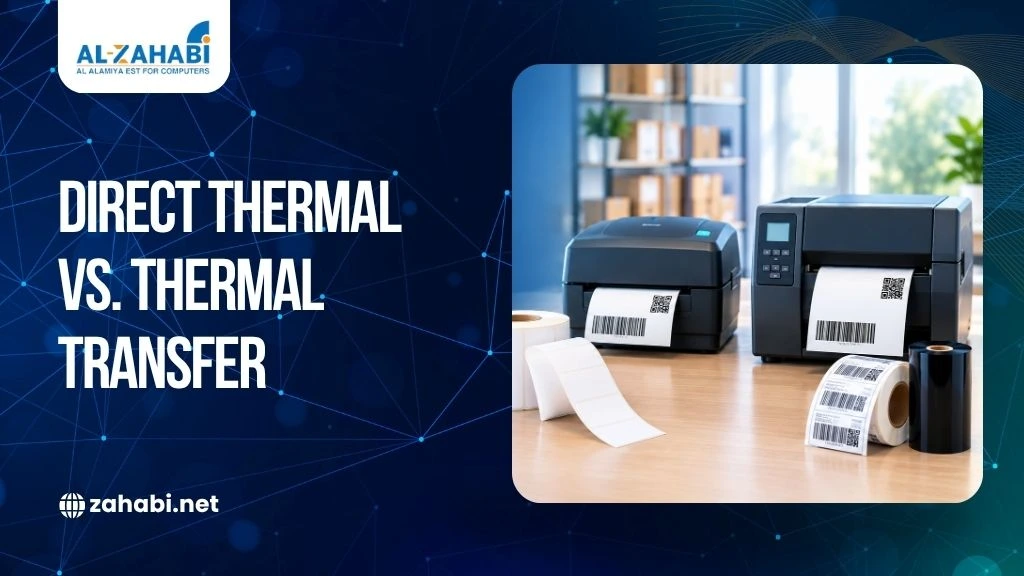
A label may look perfect today, but will it stay readable weeks or months from now?
That depends on where it is used, how long it needs to last, and what it is exposed to. Heat, moisture, sunlight and friction can all affect label quality.
If you’re comparing direct thermal vs thermal transfer labels, the right choice comes down to the job. Direct thermal works well for short-term labels, while thermal transfer is often better suited for labels that need greater durability.
Let’s look at the key differences and help you choose the right one.
Key Takeaways:
- Direct thermal labels print without a ribbon and suit many short-term applications.
- Thermal transfer labels use a ribbon and can support more durable applications.
- Label material matters as much as the printing method.
- Your environment and required label lifespan should drive the decision.
- The right printer, media and ribbon combination helps maintain print quality.
What Is Direct Thermal Printing?
Direct thermal printing uses specially treated, heat-sensitive media. The printer’s printhead applies heat directly to the label, creating the printed image without requiring a ribbon. SATO’s printer documentation confirms that direct thermal printing uses direct thermal media, while a ribbon is required for thermal transfer printing.
This makes the process relatively simple. You load the appropriate media, configure the printer and print.
Direct thermal labels are commonly used when the printed information does not need to remain readable for an extended period or when the label will not face demanding environmental conditions.
Zebra lists direct thermal materials for applications including transportation and logistics, inventory management, manufacturing work-in-process and retail shelf or product labelling.
Where Direct Thermal Labels Make Sense
Consider a supermarket printing temporary shelf labels or a warehouse producing short-term sorting labels. These applications may not require a label designed to withstand years of exposure.
A direct thermal solution can also be useful when you want a straightforward printing workflow without managing ribbon inventory.
However, direct thermal does not automatically mean that every label is fragile. The actual performance depends on the media construction and the conditions in which the label is used. Zebra, for example, offers direct thermal synthetic materials designed for specific environments.
What Is Thermal Transfer Printing?
Thermal transfer printing works differently. Instead of heating the label’s surface directly, the printhead heats a ribbon, transferring the image onto the label material.
That ribbon becomes an additional part of your printing setup. SATO describes thermal transfer as printing with a ribbon, while direct thermal uses direct thermal media.
The advantage is flexibility. Thermal transfer printers can work with different label materials, including synthetic media designed for applications where resistance to moisture, abrasion, chemicals or other environmental factors matters.
For example, Zebra lists a thermal transfer polyester label designed for location identification that is resistant to tearing, water, abrasion and moderate to harsh chemicals and solvents.
Where Thermal Transfer Labels Make Sense
Suppose you need to label warehouse locations, industrial components or products that may experience frequent handling. In these situations, you may need more than a label that simply prints clearly on day one.
A properly selected thermal transfer label and ribbon combination can provide the durability needed for the application.
For businesses looking for a thermal transfer label in Kuwait, the key question should therefore be the operating environment rather than simply the initial price of the label.
Direct Thermal vs Thermal Transfer Labels: Key Differences
The most important difference is how the image gets onto the label.
Factor | Direct Thermal | Thermal Transfer |
Printing method | Heat-sensitive media is heated directly | Ribbon transfers image onto media |
Ribbon | Not required | Required |
Media | Special direct thermal media | Wider range of media available |
Typical use | Shorter-life or frequently replaced labels | Durable and longer-life labels |
Environmental resistance | Depends heavily on media | Can be selected for demanding environments |
Supply management | Media only | Media plus ribbon |
Material flexibility | More limited | Generally broader |
Best selection factor | Label lifespan and environment | Durability and material requirements |
The distinction is important because the cheapest printing method is not necessarily the lowest-cost solution overall.
If a label needs to be replaced frequently because its information becomes unreadable, the labour and material involved in replacement can outweigh the initial saving.
How Long Does Your Label Need to Last?
Label lifespan should be one of the first questions you ask.
A label used for a few days has different requirements from one expected to remain attached to an asset for several years.
1. Short-Term Applications
Direct thermal can be appropriate for applications such as:
- Temporary inventory labels
- Retail shelf labels
- Short-term logistics identification
- Some shipping applications
- Work-in-process labels
Zebra’s certified supplies guide specifically identifies direct thermal materials for high-volume shipping, food labelling, work-in-process and other short-life applications.
2. Longer-Term Applications
Thermal transfer becomes more attractive when you need labels to withstand demanding conditions.
Examples include:
- Warehouse location labels
- Asset identification
- Industrial product identification
- Outdoor applications
- Labels exposed to moisture or abrasion
The exact result depends on the label material and ribbon combination, so selecting the printing method alone is not enough.
Environment Matters More Than You Think
A label can perform well inside an office and fail when moved into a warehouse, refrigerated area or outdoor environment.
Before selecting media, consider:
- Heat: Will the label experience high temperatures?
- Cold: Will it be stored in refrigeration or freezer conditions?
- Moisture: Could water or condensation reach the label?
- Abrasion: Will workers repeatedly handle or rub against it?
- Chemicals: Could cleaning agents, oils or solvents contact the label?
These questions can change the recommendation.
For example, Zebra lists a direct thermal polypropylene label designed to resist moisture and operate across a specified temperature range, showing why the material specification matters alongside the printing method.
If your application involves unusual conditions, review the media specification rather than assuming that all direct thermal or thermal transfer labels behave the same way.
Where labels are used in demanding warehouse conditions, rugged barcode scanners for demanding warehouse environments can complement durable labelling by supporting reliable scanning during repeated handling.
A Practical Barcode Label Material Guide
The printing method is only one part of the decision. You also need to consider the actual label material. Understanding barcode label material selection for different industries can help you choose materials that match the required durability, environment, and application.
1. Paper Labels
Paper is commonly used for general-purpose indoor applications where extreme durability is not required.
It can be suitable for retail, inventory, and short-term logistics labelling.
For example, Zebra identifies direct thermal paper labels for retail shelf and product labelling, transportation and logistics, and manufacturing work-in-process applications.
2. Synthetic Labels
Synthetic materials can be useful when you need greater resistance to moisture, tearing or abrasion.
Polypropylene and polyester are examples of materials used for applications requiring additional durability.
A warehouse location label, for instance, may need to remain readable despite repeated contact with boxes, equipment and cleaning processes.
3. Adhesive Selection
Do not overlook the adhesive.
A label can have excellent print quality and still fail if it does not adhere properly to the surface.
Zebra’s supplies portfolio includes permanent and removable adhesives as well as materials designed for specific temperature conditions.
The surface itself also matters. Corrugated cardboard, plastic, metal and coated packaging can require different label constructions.
What About Cost?
Cost comparison becomes more useful when you look beyond the price of one roll.
Direct thermal printing has one obvious supply advantage: you do not need a ribbon. That can simplify purchasing and reduce the number of consumables you need to manage.
Thermal transfer requires ribbons, but that additional supply can be justified when the application needs durable printing.
Think about the complete operating cost:
- Label material
- Ribbon consumption
- Printer maintenance
- Label replacement
- Labour
- Downtime
- Reprinting
- Product or asset identification errors
For example, replacing an inexpensive warehouse label every few weeks can become more expensive than selecting a more durable label from the beginning.
The goal is not to choose the cheapest label. It is to choose a label that performs for the required lifespan.
Choose the Printer Alongside the Label
Your printer should support the media you actually intend to use.
Some printers support both direct thermal and thermal transfer printing. Comparing thermal vs inkjet barcode printer options can also help you understand which printing technology fits your label type, workflow and expected print volume.
Zebra’s ZD411 and ZD421 desktop printer ranges, for example, are available with both printing technologies.
This can be useful if your business has different labelling requirements.
You might use direct thermal media for temporary warehouse labels while using thermal transfer for durable asset labels.
Before purchasing, check:
- Supported printing technology
- Label width and length
- Print resolution
- Media compatibility
- Ribbon compatibility
- Daily print volume
- Connectivity requirements
If you’re evaluating equipment, our Barcode Printing category can be a useful starting point for understanding the printer and consumable options available for different workflows.
Why the Ribbon Matters in Thermal Transfer Printing
If you choose thermal transfer, don’t treat the ribbon as an afterthought.
The ribbon needs to work with both your printer and label material. Zebra notes that its thermal transfer ribbons are matched to label materials to support consistent, long-lasting results. (Zebra)
Thermal transfer ribbons are available in different formulations, including wax, resin and wax/resin options. Zebra’s industrial printer documentation identifies these ribbon formulations as part of its thermal transfer supplies portfolio. (Zebra)
The right combination depends on the application.
For general indoor paper labels, a different ribbon requirement may apply than for synthetic labels exposed to abrasion or chemicals.
This is why buying the cheapest compatible ribbon is not always the right approach.
Direct Thermal vs Thermal Transfer for Different Business Applications
Your industry can provide a useful starting point, but the actual operating conditions still matter.
1. Retail
Retail businesses may use direct thermal labels for shelf pricing, temporary promotions and certain inventory applications.
A store changing promotional pricing regularly may benefit from a simple direct thermal workflow.
If you also operate checkout counters, related Receipt Printer solutions can help you build a more complete printing setup for point-of-sale operations.
2. Warehousing and Logistics
Warehouses may need both technologies.
Direct thermal can work for short-term sorting and inventory labels, while thermal transfer may be more suitable for durable location or asset identification.
If employees scan labels while moving around the facility, pairing reliable labels with Mobile Computer solutions can help support a more connected workflow.
3. Manufacturing
Manufacturing environments often place greater demands on labels. When labels form part of production identification, manufacturing barcode systems for production traceability can help connect printed product information with broader manufacturing workflows.
Heat, chemicals, abrasion and long storage periods can make durable media important. In these cases, thermal transfer can provide more material flexibility.
4. Healthcare
Healthcare labelling can involve small labels, high readability requirements and specialised environments. Zebra, for example, offers healthcare printer configurations in both direct thermal and thermal transfer versions.
The appropriate choice should therefore be based on the specific label, environment and application.
When Direct Thermal Is the Better Choice
Direct thermal is worth considering when:
- You need simple printing.
- Labels are replaced regularly.
- You do not want ribbon management.
- The application is mainly indoors.
- Long-term durability is not a major requirement.
A retail shelf label that changes frequently is a straightforward example.
If your application matches these conditions, adding a ribbon may provide little practical benefit.
When Thermal Transfer Is the Better Choice
Thermal transfer is worth considering when:
- Labels need longer-term readability.
- You need synthetic label materials.
- Labels face abrasion or moisture.
- Products move through demanding environments.
- You need greater flexibility in media selection.
A warehouse location label that needs to remain readable through repeated handling is a practical example.
However, thermal transfer is not automatically the answer for every durable application. The label material, adhesive, ribbon and printer settings all need to be compatible.
Don’t Forget the Rest of Your Printing Workflow
Labels rarely operate on their own.
A retailer may need barcode printers for product labels, receipt printers at checkout, POS machines for transactions and price checker kiosks for customer-facing product information.
Similarly, a warehouse may combine barcode printing with mobile computers and scanners.
Businesses issuing employee identification may have separate requirements covered under ID Cards & Accessories, while self-service environments may rely on Kiosk equipment.
This wider view helps you select technology based on the complete workflow rather than buying individual devices in isolation.
A Simple Decision Framework
If you are still unsure which option to choose, work through these questions:
- How long must the label remain readable?
Short-term requirements may point towards direct thermal. Longer-term requirements may favour thermal transfer.
- Where will the label be used?
Indoor retail conditions differ from warehouses, refrigerated storage and outdoor environments.
- Will the label face moisture or abrasion?
If yes, investigate synthetic media and durable thermal transfer combinations.
- Do you want to manage ribbons?
Direct thermal eliminates ribbon handling, while thermal transfer requires ribbon selection and replacement.
- What does your printer support?
Always confirm printer and media compatibility before purchasing supplies.
For broader identification requirements, comparing RFID vs barcode inventory identification technologies can help you assess whether printed labels or RFID-based tracking better fits the workflow.
If you are unsure, test the exact printer, label and ribbon combination under real operating conditions before placing a large consumables order.
Conclusion
The choice between direct thermal vs thermal transfer labels comes down to the job the label needs to perform. Direct thermal can simplify short-term printing, while thermal transfer offers greater flexibility when durability and material choice matter.
Before you decide, consider label lifespan, environment, material, adhesive, printer compatibility and total operating cost. A properly matched printer and label combination can reduce reprints and keep important information readable throughout its intended use.
Frequently Asked Questions
1. Are direct thermal labels cheaper than thermal transfer labels?
Direct thermal printing can reduce consumable complexity because it does not require a ribbon. However, the overall cost depends on media, replacement frequency, labour and application requirements. A thermal transfer label may cost more initially but can be more suitable when longer durability reduces replacement and reprinting.
2. How do I choose a thermal transfer label in Kuwait?
Start with the environment rather than the printer price. Consider heat, moisture, abrasion, chemicals, storage duration and the surface being labelled. Then select compatible label material, adhesive, ribbon and printer specifications. For demanding applications, test the complete combination before purchasing large quantities.
3. Can one printer use both direct thermal and thermal transfer labels?
Some printers support both printing methods, but the exact capability depends on the model. For example, Zebra’s ZD411 and ZD421 desktop printers are offered with direct thermal and thermal transfer capabilities. Always check the manufacturer’s specifications before buying media or ribbons.
4. What label material should I use for warehouse applications?
The right material depends on the warehouse environment and how long the label must remain readable. Paper can work for many general indoor applications, while synthetic materials can be considered where moisture, abrasion or harsher conditions are concerned. Always check the material’s stated operating conditions.
5. Do thermal transfer labels need special ribbons?
Yes. Thermal transfer printing requires a ribbon, and the ribbon should be matched to the printer and label material. Common ribbon formulations include wax, resin and wax/resin. The correct choice depends on the required durability, label surface and application conditions.


Add comment